
Last updated: August 20, 2026
Jon boats are the easiest hulls in the world to buy and one of the easiest to put on the wrong trailer. They are light, flat bottomed and forgiving on the water, which tempts owners into treating the trailer as an afterthought and grabbing whatever small utility rig comes up cheap locally. Then the hull sits unsupported at the transom, the bunks end in the wrong place, and the aluminum starts to show it.
This guide covers how to size a trailer for a jon boat properly: which numbers decide it, where those numbers actually come from, and how bunk length and placement matter as much as the rating on the plate. There is no universal chart that fits every hull, but there is a reliable order of operations.
This article contains affiliate links. If you buy through them, we may earn a commission at no extra cost to you. Learn more.
Quick Answer
What size trailer do you need for a jon boat?
- Start with the trailer’s rated capacity from its capacity plate or VIN sticker, and compare it against your boat, motor, battery and gear together.
- The trailer bed has to be long enough that the transom is supported, not overhanging past the end of the bunks.
- Bunk spacing has to suit a flat bottom hull, which loads differently from a V-hull and needs support closer to the chines.
- Check the boat manufacturer’s published hull weight and beam, then confirm both against the trailer maker’s own listing.
Bottom line: buy on published capacity and supported length, never on a guess from the boat’s stated feet.
Why a Jon Boat Is a Different Trailering Problem
A jon boat has a flat or slightly modified V bottom, low freeboard and very little keel. There is no deep centerline for a roller to track along and no deadrise to center the hull as it comes up. That means the trailer has to do the aligning work through bunk placement rather than through hull shape.
The second difference is weight distribution. Jon boats carry their mass low and often stern heavy once a motor, battery and fuel tank are aboard. A trailer that supports the middle and leaves the transom hanging concentrates all of that where the aluminum is thinnest.
What Poor Support Actually Does
Unsupported transoms and badly spaced bunks show up as oil-canning in the bottom sheet, popped or weeping rivets along the chine, and a hull that develops a permanent hollow between supports. None of that happens on one trip. All of it happens over a few seasons of highway miles.
The Numbers That Decide the Trailer
Four figures settle the question: the loaded weight of the boat as you actually use it, the hull length, the beam at the transom, and the trailer’s own published capacity. The first three come from the boat manufacturer and a tape measure, and the fourth is printed on the trailer’s capacity plate or VIN sticker.
Loaded weight is where owners underestimate. The published hull weight of a jon boat covers the bare aluminum. An outboard, a battery, a fuel tank, a trolling motor, seats, an anchor and a cooler add up to a meaningful share of the total, and all of it rides on the trailer.
Where to Find Each Number
Hull weight and beam come from the boat manufacturer’s specification page or the capacity plate on the boat itself. Motor weight comes from the outboard manufacturer. Trailer capacity comes from the trailer’s plate. If any of those is missing or unreadable, a trip across a truck scale with the rig hitched settles the loaded figure without guesswork.
Length, Overhang and Bunk Placement
Trailer length is quoted for the bed, and what matters is how much of your hull it supports. The transom should sit over or just ahead of the end of the bunks, with the bow eye reaching the winch stand comfortably. A hull hanging well past the bunk ends has its heaviest point unsupported.
A short overhang at the stern is normal on many rigs, but a long one is a fitment problem rather than a preference. If the boat sits that far back, either the bunks need to move rearward within their adjustment range or the trailer is too short for the hull.
Flat Bottom Bunk Spacing
On a flat bottom hull the bunks should sit out toward the chines rather than clustered near the centerline, so the load spreads across the strongest part of the bottom. Carpeted bunks are the standard choice because they let the hull slide on and off without scuffing the aluminum, and they hold the boat straight once it is home.
How to Size Your Trailer Step by Step
| Step | What to measure | Where the number comes from | Why it matters |
|---|---|---|---|
| 1. Loaded weight | Hull plus motor, battery, fuel, gear | Boat and motor manufacturer specs, or a truck scale | Sets the minimum trailer capacity |
| 2. Hull length | Bow to transom, actual not nominal | Tape measure on the boat | Decides bed length and overhang |
| 3. Beam at transom | Widest point across the stern | Tape measure or manufacturer spec | Decides bunk spacing and frame width |
| 4. Trailer rating | Capacity plate or VIN sticker | Trailer manufacturer | The only rating that legally applies |
Setting Up the Trailer You Have
Bunks That Fit the Hull
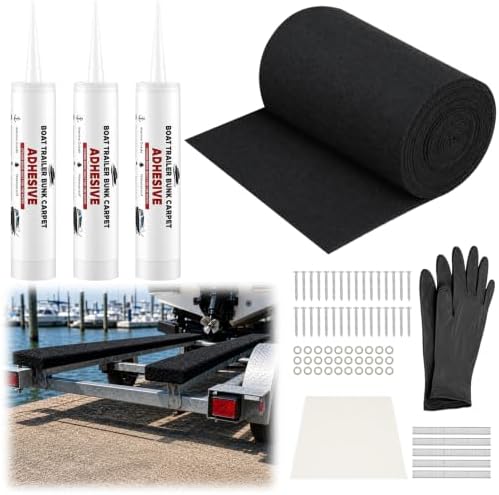
Most sizing complaints on jon boat trailers come down to bunks that are too short or in the wrong position rather than a frame that is genuinely undersized. Replacement carpeted bunk boards let you set length and spacing to suit a flat bottom, which is usually a cheaper fix than a different trailer.

Loading a Flat Bottom Hull Straight
Without a keel to guide it, a jon boat wanders on the bunks as it comes up. Post-style guide-ons give the hull something to find on both sides, which makes solo loading realistic and stops the boat landing off center every time.

Refreshing Worn Bunk Carpet
Bunk carpet wears through, and bare wood or an exposed staple against an aluminum hull leaves marks quickly. Recarpeting is a straightforward afternoon job and worth doing before the season rather than after you notice the scratches.
Registration, Width and Local Rules
Trailer registration, title requirements, lighting rules and maximum widths are set by each state rather than nationally, and they differ enough that a rule from a neighboring state is not a safe assumption. Check your state’s boating or motor vehicle agency for what applies where the trailer is registered.
The same goes for whether a small utility trailer can be titled as a boat trailer, and what documentation a dealer needs to provide. These are quick questions to the agency and expensive ones to get wrong at a registration counter.
Common Mistakes When Buying a Jon Boat Trailer
Buying by the boat’s nominal length is the classic error. A hull sold as a certain number of feet is often a little longer or shorter in reality, and the trailer bed that matches the label may not match the boat. Measure the actual hull.
Sizing to the bare hull weight is the second, and reusing a V-hull trailer without moving the bunks is the third. A trailer set up for a deadrise hull supports a flat bottom in exactly the wrong places, and the bunks usually need repositioning even when the frame is fine.
Frequently Asked Questions
Can I put a jon boat on a utility trailer? Only with proper bunks fitted and enough supported length for the transom. A flat deck utility trailer without bunks concentrates load in the wrong places and does not hold the hull steady on the road.
How much capacity does a jon boat trailer need? More than the boat’s published hull weight, because the motor, battery, fuel and gear all ride along. Compare your loaded weight against the capacity on the trailer’s plate, and leave margin rather than sitting at the limit.
Should a jon boat sit on bunks or rollers? Bunks suit flat bottom aluminum hulls because they spread load over a wide area and hold the boat straight. Rollers concentrate load at points, which is less kind to a thin aluminum bottom.
How far can the transom overhang the bunks? As little as possible. The stern carries the motor and is the heaviest part of a loaded jon boat, so aim to have the transom supported at or just ahead of the bunk ends rather than hanging past them.
Do I need a bigger trailer if I add a trolling motor and batteries? Not necessarily a bigger trailer, but recalculate. Batteries in particular add real weight, and the addition can push a rig that was comfortably inside its rating up against it.
Does my jon boat trailer need to be registered? That depends entirely on your state. Registration, titling and lighting requirements for boat trailers are set at state level, so check with your state’s boating or motor vehicle agency.
The Bottom Line
Sizing a trailer for a jon boat is four numbers and one principle: loaded weight against the trailer’s rated capacity, actual hull length and transom beam against the bed and bunk layout, and enough support under the stern that the aluminum is not carrying itself. Adjust the bunks before you conclude the trailer is wrong. For the bunk versus roller decision our rollers or bunks guide goes deeper, and our trailer guide-ons guide covers loading a keel-less hull straight.