Last updated: August 20, 2026
A pontoon without shade is a griddle. The deck is wide open, the furniture is vinyl, and there is nothing between the sun and everyone aboard except whatever canopy the boat came with. When that original top finally gives up, most owners discover the replacement is not as simple as ordering the same size as a runabout owner would.
Pontoon biminis follow different measuring logic. The frame usually mounts to the deck rail rather than the gunwale of a hull, the widths run wider than anything sold for a V-hull, and the length you need depends on how much of the deck you want covered rather than on the boat length. This guide walks through the measurements in order, so the top you order actually bolts to the boat you own.
This article contains affiliate links. If you buy through them, we may earn a commission at no extra cost to you. Learn more.
Quick Answer
How do you measure a pontoon for a bimini top?
- Measure rail to rail at the exact mounting point, inside face to inside face, not the deck width.
- Pick length by how much deck you want shaded, most commonly a longer four bow span on a pontoon.
- Height is measured from the mounting bracket up, and needs to clear standing headroom over the furniture.
- Confirm the mount style: rail mount brackets and deck mount hinges are not interchangeable.
Bottom line: pontoon widths run wider than V-hull sizes, so buy from a pontoon width range and confirm the bracket type before anything else.
Why a Pontoon Bimini Is Sized Differently
A pontoon deck is a flat rectangle with rails, not a tapering hull with gunwales. The frame mounts to the rail or to the deck inside the rail, and the span it has to cross is close to the full width of the boat. That puts pontoon widths at the top end of what universal tops offer.
The second difference is the mounting surface. On a V-hull the deck hinge sits on a sloping fiberglass gunwale. On a pontoon the bracket clamps or bolts to a vertical or square rail, which means the hardware in the box has to match your rail profile. Ordering the right canvas with the wrong bracket is the most common way a pontoon top purchase goes sideways.
Take These Measurements Before You Shop
Three numbers, in order: width across the mounting points, coverage length fore and aft, and height above the bracket. Write them down before you look at any listing, because it is very easy to talk yourself into a size that is close when close does not tension properly.
Width, Measured at the Bracket
Measure straight across the boat at the point where the brackets will sit, from the inside face of one rail to the inside face of the other. Do not measure the outside of the rails and do not use the published deck width from the brochure. Manufacturers publish tops in width ranges, so your number should land comfortably inside a range rather than at its limit.
Length and Height
Length is a coverage choice. Most pontoon owners want shade over the helm and the main seating group, which usually points to a longer top rather than a short one. Height is measured from the top of the bracket to the underside of the canvas, and it needs to leave real standing headroom, because people move around a pontoon deck far more than they do in a bowrider.
Pontoon Bimini Options by Situation
Full Replacement for a Tired Factory Top
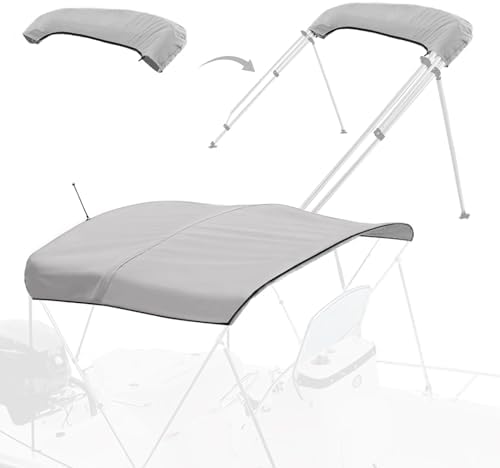
When the canvas has gone chalky and the fittings are seized, a complete top with frame, canvas, straps and hardware is the cleaner path than piecing it together. Buy from the pontoon width ranges rather than the standard boat ranges, and check that the kit lists rail mount brackets.

Frame Is Good, Canvas Is Finished
Anodized aluminum frames outlast the fabric on them by years. If your bows are straight and the hinges still move, replacement canvas cut to your existing bow count, width and height saves both money and an afternoon of assembly.
Mounting to an Awkward Rail
Square rails, round rails and rails with an odd wall thickness all exist on pontoons, and factory brackets are not universal. Separate rail mount brackets solve fitment when the canvas you want does not come with hardware that matches your boat.

Keeping the Folded Top Quiet on the Trailer
A pontoon top folds into a long stack that sits high above the deck, which makes it an easy target for wind on the highway. A storage boot plus proper straps keeps the canvas from working loose and chafing along the fold lines.

Comparing Pontoon Top Configurations
| Configuration | Mounting | Coverage | Watch for |
|---|---|---|---|
| Four bow rail mount | Brackets on the rail | Helm plus main seating | Rail profile must match the bracket |
| Three bow rail mount | Brackets on the rail | Helm area only | Rear lounge stays in the sun |
| Replacement canvas | Uses existing frame | Same as original | Bow count, width and height must match exactly |
| Deck mount conversion | Hinges bolted to deck | Depends on span | Adds holes, check what is underneath |
Fabric Choices That Matter on a Pontoon
A pontoon top spends more hours deployed than most V-hull biminis, because the boat gets used for slow cruising and long anchored afternoons rather than short runs. That means UV exposure is the main enemy, and fabric that holds color matters more here than on a boat that mostly sits covered.
Solution dyed polyester is the common choice and performs acceptably for the money. Acrylic canvas costs more and typically holds color longer. Whichever you choose, treating the fabric with a marine fabric guard before it starts leaking, rather than after, is what keeps water beading instead of soaking through the weave.
Installation Realities Worth Knowing
Assembly is a two person job on a pontoon simply because the spans are long. One person holds a bow square while the other sets the bracket, and getting the frame square before you tighten anything is what prevents a top that pulls to one side when tensioned.
Do not drill into a rail or deck until you have test fitted the whole frame loosely. Aluminum rails on pontoons often have internal structure in specific places, and a hole in the wrong spot is permanent. If your boat has a factory bracket footprint already, reusing those holes is almost always the better outcome.
Frequently Asked Questions
What size bimini top fits a pontoon boat? The one whose width range covers your rail to rail measurement at the bracket point. Pontoon widths run wider than V-hull sizes, so measure first and shop the pontoon ranges rather than assuming a standard boat size fits.
Can I use a regular boat bimini on a pontoon? Sometimes, if the width range reaches far enough and the brackets suit your rail. More often the width falls short or the deck hinge does not match a rail profile, which is why pontoon specific kits exist.
Do I have to replace the whole top or just the canvas? If the frame is straight and the fittings work, replacement canvas matched to your bow count, width and height is enough. Replace the whole assembly when bows are bent or fittings are seized.
How tall should a pontoon bimini be? Tall enough that people can stand under it comfortably, since a pontoon deck is a walking around boat. Remember that a taller top raises the folded stack and catches more wind while towing.
Can I leave it up while trailering the pontoon? No. Fold it, boot it and strap it. Highway air loads bend bows and tear stitching, and a pontoon top sits high enough to take the full force of it.
Will a bimini keep rain off the furniture? Only what is directly underneath while the boat sits still. For actual protection you need a mooring or travel cover, which is a separate product from the shade top.
The Bottom Line
A pontoon bimini is a fitment purchase, and the fitment is decided by two things most listings bury: the rail to rail width at the bracket, and whether the included hardware matches your rail. Get those right and the rest is a coverage and headroom preference. For protecting the boat rather than the passengers, see our pontoon cover sizing guide, and for the wider sizing logic behind shade tops in general there is our bimini top buying guide.