Last updated: August 20, 2026
A boat cover has three enemies and they are all patient. Sunlight breaks down the fabric and everything under it, rain finds the low spot and pools there until something gives, and the wind spends every windy night working at whatever is loose. A cover that handles all three is a cheap insurance policy. A cover that handles two of them turns into a shredded tarp by August.
This guide covers how to buy a universal fit cover that actually stays on, what the sizing numbers on the listing mean, and the difference between a cover you trailer with and a cover that only ever sits in the driveway. It is honest about the tradeoff too: a custom cover made for your exact hull fits better and lasts longer, but it costs a multiple of a universal one, and most trailerable boats are perfectly well served by choosing a universal cover carefully.
This article contains affiliate links. If you buy through them, we may earn a commission at no extra cost to you. Learn more.
Quick Answer
How do you choose a boat cover that stays put?
- Measure centerline length and maximum beam, then buy the model whose published range covers both.
- Match the cover style to your hull type. A V hull cover, a center console cover and a pontoon cover are not interchangeable.
- If you tow with it on, buy a cover rated as trailerable and use its strap system, not bungee cord.
- Add a support pole. Pooled water is what destroys covers, and a pole is the fix.
Bottom line: correct measurements plus the right style plus a support pole beats paying more for heavier fabric that still pools water.
Universal Fit, Honestly Described
A universal cover is cut to a size band rather than to your hull, so it fits a range of similar boats approximately. A custom cover is patterned to your exact make, model and year, fits closely, and costs a great deal more. Both are legitimate purchases, and pretending a universal cover fits like a custom one helps nobody.
What a well chosen universal cover does deliver is full coverage, a snug hem, and a strap system that keeps it from flogging. What it will not do is follow every curve of your gunwale or clear a windshield and a bow rail without some slack. Knowing that going in is how you pick a good one.
Measuring Your Boat Properly
Two measurements decide fitment: centerline length and maximum beam. Centerline length is measured along the middle of the boat from the tip of the bow to the transom, following the deck rather than the trailer. Beam is the widest point of the hull, including a rub rail if there is one.
Manufacturers publish both figures for every model. Classic Accessories, for example, lists its StormPro covers with a stated length band and a beam width limit, such as a model that fits boats 14 to 16 feet long with beam width up to 75 inches. Your job is to fall inside both numbers, not just the length.
What Manufacturer Length Is Not
The length in your boat’s model name is a marketing number and often differs from the real centerline measurement, especially once a swim platform, a bow pulpit or an extended bracket is in the picture. Measure with a tape rather than trusting the badge on the hull side.
Fabric, Coating and Ventilation
Most universal covers are polyester in various weights with a water repellent coating, and the coating is what wears out first. Heavier fabric resists abrasion and UV better, which is why covers intended for full season outdoor storage are noticeably thicker than a light dust cover for a garage.
Ventilation matters as much as the fabric. A sealed cover over a damp interior grows mildew reliably, which is why quality covers include vents. Classic Accessories describes dual rear air vents on its StormPro covers to reduce wind pressure while trailering and let interior moisture escape, which is exactly the pair of jobs vents are there to do.
Waterproof Versus Water Resistant
No breathable fabric cover is a sealed lid, and one that were would trap moisture underneath. What you want is a coating that sheds rain and a shape that gets the water off the cover instead of holding it. Recoating with a canvas treatment when the fabric starts wetting through extends the life considerably, which our guide to boat cover waterproofing spray covers in detail.
Boat Cover Picks by Situation
Outdoor Storage Through the Season
A heavy duty universal cover with a coated marine grade fabric, an elastic hem cord and an integrated strap system is the standard pick for a boat that lives outdoors between trips.
Towing With the Cover On
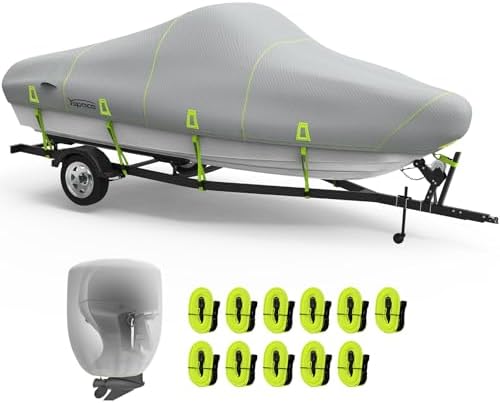
Trailering puts loads on a cover that mooring never does. Look specifically for a cover described as trailerable, with a buckle and strap system rather than a drawcord alone, and vents that relieve wind pressure at speed.

Stopping Water From Pooling
Almost every destroyed cover was destroyed by standing water. A support pole under the middle creates a peak so rain runs off instead of collecting, and it is the single highest value accessory you can add.

Keeping the Cover From Flogging
Loose fabric in the wind saws through itself at the seams. A tie down kit with rope or straps under the hull, plus the cover’s own hem cord pulled tight, keeps the whole thing quiet in a blow.

Pontoons Need a Different Shape
A pontoon deck is a rectangle with a rail around it, not a tapering hull, so pontoon covers are cut and sized differently. Buy the pontoon specific version rather than a V hull cover in a large size.

Cover Types Compared
| Cover type | Designed for | Fit quality | Notes |
|---|---|---|---|
| Universal storage cover | Sitting in the driveway or the yard | Approximate, by size band | Add a support pole and tie downs |
| Universal trailerable | Towing plus storage | Approximate, with a strap system | Check the vents and buckle quality |
| Semi custom | A named hull style and size | Closer, cut for the style | Middle ground on cost and fit |
| Custom fit | Your exact make, model and year | Close, follows the hull | Costs a multiple of universal |
Fitting It So It Survives the Winter
Start by removing or padding anything sharp. Antenna bases, cleats, bow rails and windshield corners are where covers wear through, and a piece of pipe insulation or a purpose made pad at each contact point costs almost nothing and adds seasons. Take the antenna off entirely if it unscrews.
Then build the shape before you tension the hem. Set the support pole so the peak is high enough that water runs off rather than sitting anywhere, pull the hem cord evenly rather than yanking one side, and run the straps under the hull in a pattern that resists wind from the front, since that is the direction that gets under a cover.
Ventilation and Mildew
Leave the interior as dry as you can before covering, prop lockers and the engine hatch slightly open where practical, and keep the cover vents clear. A moisture absorber in the cabin or under the console handles the rest, and that is a small cost against a season of mildew stains on vinyl.
Frequently Asked Questions
What size boat cover do I need? Measure centerline length from bow tip to transom along the middle of the boat, and maximum beam at the widest point including the rub rail. Then buy the model whose published length band and beam limit both cover your numbers, not just the length.
Is a universal boat cover good enough? For most trailerable boats, yes, provided you measure correctly and add a support pole and tie downs. A custom cover fits closer and lasts longer, and it costs a multiple of a universal one, so the honest answer depends on how the boat is stored and what you want to spend.
Can I tow with a boat cover on? Only with a cover described as trailerable, fitted using its strap system rather than bungee cords. Highway airflow will find any loose section and work at it, so tension and vents matter more at speed than they do in the driveway.
How do I stop water pooling on my boat cover? Use a support pole to create a peak so rain runs off. Pooled water is the most common way covers fail, because the weight stretches the fabric and creates a lower spot, which collects more water.
Do boat covers cause mildew? A cover over a damp interior with no airflow will. Choose a cover with vents, dry the interior before covering, prop lockers slightly open where you can, and consider a moisture absorber inside.
How long does a boat cover last? It depends on fabric weight, sun exposure and how well it is tensioned. Covers that pool water or flog in the wind fail quickly regardless of quality, while a well supported, well strapped cover in a moderate climate lasts several seasons and can be recoated along the way.
The Bottom Line
Measure centerline length and beam, buy the universal cover whose published range covers both, and be clear eyed that universal means close rather than tailored. Then spend the small extra on a support pole and a proper tie down kit, because pooling and flogging are what actually destroy covers. If your boat has a console or a hardtop, sizing gets more specific, and our guide to the center console boat cover picks up from there.