Last updated: August 20, 2026
A torn boat cover rarely gives out because the fabric was bad. It fails because water found a low spot, sat there, got heavy, and then froze. A few gallons of rain in the cockpit is a surprising amount of weight hanging on a seam, and once ice is involved the cover either stretches permanently or lets go at a grommet.
Support poles solve that by turning a flat cover into a tent. They are one of the cheapest items in boat storage and one of the most consequential, and the difference between a single pole and a proper pole-and-strap system is bigger than most owners expect. This guide covers the formats, how to size them, and where they need protection.
This article contains affiliate links. If you buy through them, we may earn a commission at no extra cost to you. Learn more.
Quick Answer
Do you need boat cover support poles?
- Yes, on any covered boat stored outdoors. Water pooling is the main cause of cover failure.
- A single adjustable pole handles a small boat; longer boats need multiple poles plus webbing straps.
- Pontoons need a dedicated system, because a flat deck cannot shed water without forced ridges.
- Every pole needs a padded or capped tip, otherwise it eventually pushes through the fabric.
Bottom line: buy by boat length and the height you need, and never set a pole against a cover without a protective tip.
What Support Poles Actually Do
A support pole lifts the middle of the cover higher than the edges so rain and melting snow run down and off instead of collecting. That single change also keeps the fabric from resting on the windshield, gunwales and hardware, which is where abrasion wears a cover thin over a season.
The secondary benefit is airflow. A cover held up off the deck leaves a gap for air to move under, which slows the condensation cycle that makes a covered interior smell musty. It does not replace vents, but it helps.

Single Pole or a Full Support System
A single adjustable pole is enough on a small boat with a short cockpit, where one high point in the middle creates enough slope to shed water in both directions. Above roughly the size of a small runabout, one pole leaves long flat runs fore and aft that still pond.
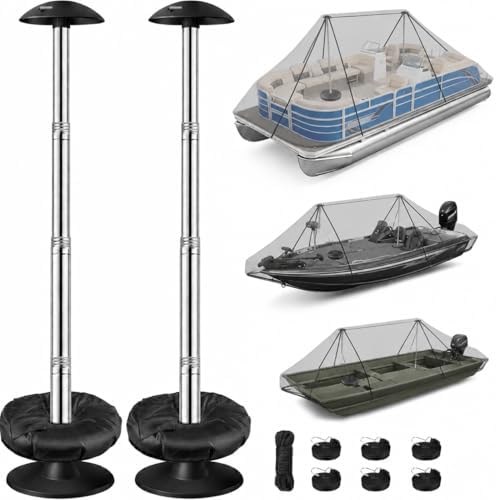
A full support system uses poles plus webbing straps that run over the cover, pulling it into ridges along its length. Taylor Made publishes systems in this format, for example a boat cover support system with an adjustable pole and polypropylene webbing strap for boats up to 23 feet, and a pontoon version with adjustable poles and longer webbing.

Sizing by Height and Boat Length
Poles are sold by their adjustment range, and the published ranges show what the categories look like. Taylor Made lists an adjustable pole in the 24 to 48 inch range for boats up to 23 feet, a 22 to 52 inch three-section pole, and a pontoon system with poles adjusting from 27 to 50 inches.
Measuring Before You Buy
Measure from where the pole will actually stand, usually the cockpit sole or a seat base, up to where the cover sits when it is on, then add the height you want the peak to rise. Buy a pole whose range brackets that number in the middle rather than at either extreme, because a pole extended to its limit is the least stable.
Pontoons Are a Different Problem
A pontoon deck is wide, flat and long, which is the geometry least able to shed water. Where a V-hull cover already slopes toward the sides, a pontoon cover has no natural slope at all, so a single pole creates one peak surrounded by acres of flat fabric that still ponds.
Pontoon systems exist for that reason and use multiple poles plus a long webbing run to create ridges down the whole deck. Buy the pontoon-specific version rather than adapting a V-hull kit, and see our pontoon cover fitment guide for how the cover itself should be sized.
Support Pole Formats Compared
| Format | How it works | Typical use | Watch for |
|---|---|---|---|
| Single adjustable pole | One peak in the cockpit | Small runabouts and utility boats | Flat runs fore and aft |
| Multi-section telescoping | Wider height range in one pole | Taller peaks, deeper cockpits | Stability at full extension |
| Pole plus webbing system | Straps pull the cover into ridges | Boats over about 20 feet | Strap routing over hardware |
| Pontoon system | Multiple poles, long webbing runs | Flat pontoon decks | Using a V-hull kit instead |
| Vented pole | Combines support with a cover vent | Long storage under a sealed cover | Matching the vent to the cover |
Tips, Pads and What Poles Rest On
The top of the pole is where covers get destroyed. A bare tube pressed into fabric under snow load concentrates all that force into a small circle, and eventually the pole punches through. Every pole should have a padded cap, a rubber tip or a wide plastic disc between the tube and the cover.
The bottom matters too. A pole standing on a gelcoat sole will mark it, and one standing on a cushion will crush it. Use a crutch tip or a base pad, and stand the pole on something structural such as a seat base or the sole rather than on a hatch lid that flexes.

Mistakes That Undo the Whole Point
Setting one pole and calling it done on a long boat is the most common. Check the cover after the first heavy rain and look for standing water anywhere along its length. If there is a puddle, that spot needs either another pole or a strap pulling the fabric into a ridge.
The second is over-extending a pole to force a dramatic peak, which stresses the cover fabric and the tie-downs and makes the pole itself unstable. The third is skipping the tip pad, and the fourth is leaving support poles in place while trailering, where they can shift and tear the cover at highway speed.
Frequently Asked Questions
How many support poles does a boat cover need? Enough that no section of the cover holds standing water. Small boats often manage with one, and boats above about 20 feet usually need a pole plus webbing straps to create ridges along the full length. Check after the first heavy rain and add support where water sits.
What height should a boat cover support pole be? Measure from the surface the pole stands on to the underside of the cover as fitted, then add the peak height you want. Choose a pole whose adjustment range puts that number near the middle of its travel rather than at maximum extension.
Can I use a piece of PVC pipe instead? Owners do, but a homemade pole has no adjustment, no padded tip and no base pad, which are exactly the parts that protect the cover. If you go that route, cap both ends properly and pad the top.
Do support poles work with shrink wrap? Shrink wrap uses its own temporary frame rather than a cover support pole, since the film is heated tight against the structure. The principle is identical, build a peak so water sheds, but the hardware is different.
Should I leave the pole in while trailering? No. Support poles are for storage. On the road the pole can shift under wind load and tear the cover, and a trailering cover should be strapped tight against the boat rather than tented up.
Do pontoon boats need a different pole system? Yes. A flat pontoon deck cannot shed water on its own, so pontoon systems use multiple poles and long webbing runs to build ridges across the whole deck. A single V-hull pole leaves large flat areas that pond.
The Bottom Line
A support pole is the cheapest insurance a boat cover can have. Size it by measuring from the surface it stands on to the cover, buy a pole whose range puts that height mid-travel, pad both ends, and add webbing straps once the boat is long enough that one peak leaves flat runs. Pontoons need their own system. See our boat cover buying guide for fit and tie-downs, and our winter cover comparison for the storage decision.