
Last updated: August 20, 2026
A battery box looks like the least interesting purchase on the boat, which is exactly why so many boats have the wrong one. A battery sitting in an oversized box, or held by a perished strap, or with a bare positive terminal a few inches from an aluminum bracket, is a problem waiting for the first serious wake.
The box does three jobs: it stops the battery moving, it keeps metal objects away from the terminals, and on flooded batteries it contains acid and allows gas to escape. This guide covers how to size one, how boxes and trays differ, and what to check on the mounting so it stays put.
This article contains affiliate links. If you buy through them, we may earn a commission at no extra cost to you. Learn more.
Quick Answer
How do you choose a battery box for a boat?
- Buy for your battery’s group size, and measure the battery rather than trusting the number on the old box.
- A snug fit matters. A battery loose inside a box is barely more secure than one with no box at all.
- Flooded batteries need a vented box. Sealed AGM and lithium have fewer venting concerns but still need containment.
- Check the strap and the mounting surface, because most failures are a broken strap rather than a broken box.
Bottom line: match the group size exactly, choose a box or tray based on where it mounts, and treat the hold down strap as the part that actually does the work.
What a Battery Box Is Actually For
The first job is restraint. A marine battery is heavy, and a boat crossing a wake generates real forces, so a battery that can slide or tip becomes a projectile that can also short itself against nearby metal. The box plus its strap is what holds it in position.
The second job is isolation. A covered box keeps tools, fishing gear and tackle boxes away from the terminals, which prevents the accidental short that welds a wrench to a post. On flooded batteries the box also contains spilled electrolyte and allows charging gas to escape.
Sizing the Box to the Battery
Battery boxes are sold by group size, matching the BCI case standards that batteries use. A Group 24 battery does not fit a Group 24 box loosely, it fits snugly, and putting a Group 24 battery in a Group 27 box leaves it free to move. Buy the box for the battery you own.
Measure the battery itself before ordering, particularly if you have a lithium unit. Lithium batteries described as Group 31 sized are not always dimensionally identical to a lead acid Group 31, and a fraction of an inch decides whether the lid closes.
Terminal Clearance Is the Thing People Miss
Height is the dimension that catches owners out. A box that fits the footprint can still refuse to close once the cables are on the posts, especially with ring terminals and a battery that has taller posts than the previous one. Check the internal height against the battery plus its connected cables.
Boxes with a raised lid section or a cable notch handle this better than flat lidded designs. If the lid will not close over the terminals, the box is not protecting anything.
Boxes, Trays and Hold Downs Compared
Three approaches exist. A full box encloses the battery on all sides with a lid. A tray holds the base and uses a strap or bar over the top. A hold down bar bolts across the battery in a purpose built compartment. Each suits a different location on the boat.
| Type | Encloses | Venting | Best suited to |
|---|---|---|---|
| Full box with lid | All sides plus terminals | Vent slots in most marine designs | Open compartments and exposed positions |
| Tray with strap | Base only | Open, so airflow is unrestricted | Enclosed lockers where the lid is redundant |
| Hold down bar | Nothing, restrains only | Open | Factory compartments built for a battery |
| Dual battery box | Two batteries side by side | Vented, larger footprint | 24V banks kept together in one location |
Battery Boxes by Situation
The Standard Replacement
A Group 27 marine battery box with a strap is the most common purchase, matching the group size most often used for a trolling motor or a house battery. Attwood, Camco and Seachoice all make boxes in the common group sizes, and the strap kit is usually included.

You Have a Larger Battery
Group 31 batteries and Group 31 sized lithium packs need their own box, and cannot be squeezed into a 27. Measure the battery, including the height with cables attached, and confirm the internal dimensions in the listing rather than assuming that all Group 31 boxes are the same inside.

The Battery Lives in a Sealed Locker
Inside a dedicated compartment, a tray with a hold down strap is often the better choice than a lidded box. It restrains the battery, leaves airflow unrestricted, and takes up less height in a locker where the lid has nowhere to open into.
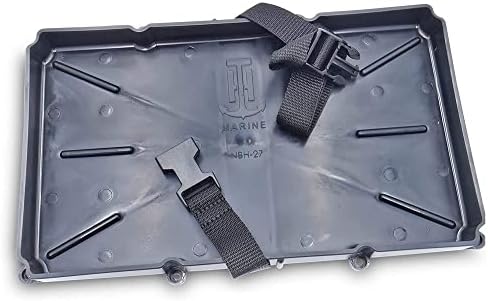
The Existing Strap Has Perished
The strap is the part that fails, usually because UV and salt have made the webbing brittle or the buckle has corroded. Replacement strap kits with stainless hardware are inexpensive, and swapping a tired strap is the highest value ten minutes you can spend on a battery installation.

Mounting It So It Stays Put
The box has to be fastened to something solid, not simply set on the deck with a strap over it. A box that is itself free to slide gives you a heavy object moving around a compartment, and the strap only helps if the anchor points are attached to structure rather than to a thin panel.
Where fasteners go through a deck or a bulkhead, sealant at the hole keeps water out of the core. Stainless hardware suits the environment, and it is worth checking the fasteners each season, since vibration and battery weight work at them continuously.
Venting Still Matters on Flooded Batteries
Flooded lead acid batteries release gas while charging, so their enclosure needs to allow that gas to escape rather than accumulate. Marine boxes are designed with vent slots for this reason, and sealing one up to keep water out defeats a safety feature.
Sealed AGM and LiFePO4 batteries reduce that concern considerably, which is one reason they are popular in tight lockers. They still need restraint and terminal protection, so the box or tray is not something to skip.
Wiring Stays With a Technician
Adding a battery, moving one, or changing how a bank is arranged is work for a marine technician, and this guide covers what to buy rather than how to wire it. What you can do is measure the compartment, note your group size and terminal type, and have the box and strap on hand so the job is done in one visit.
If you are simply replacing a cracked box with the same size, that is a straightforward swap with the battery disconnected first. Anything that involves changing cable routing or adding a second battery is a different conversation.
Frequently Asked Questions
Do I need a battery box on a boat? The battery has to be secured against movement and its terminals protected from accidental contact. A box with a strap is the standard way to achieve both, and on flooded batteries it also contains electrolyte and allows charging gas to escape.
What size battery box do I need? One that matches your battery’s group size, so Group 24, 27 or 31 as appropriate. Measure the battery, including its height with cables connected, since a box that fits the footprint may still not close over the terminals.
Can I put a Group 27 battery in a Group 24 box? No. Group sizes are physical case standards and a Group 27 is larger. Forcing the wrong pairing either does not fit or leaves the battery loose, and a loose battery in a box provides very little real restraint.
Do lithium batteries need a vented box? LiFePO4 batteries do not produce charging gas the way flooded lead acid does, so venting is less critical. They still need to be secured and their terminals protected, so a box or a tray with a strap is still the right approach.
Is a battery tray as good as a box? In an enclosed locker where nothing can fall onto the terminals, a tray with a hold down strap restrains the battery and keeps airflow open. In an exposed position, a lidded box is better because it keeps gear away from the posts.
Why does my battery strap keep breaking? UV and salt make webbing brittle over time, and corroded buckles lose their grip. Replacement strap kits with stainless hardware are inexpensive, and the strap should be treated as a wear item checked every season.
The Bottom Line
A battery box is sized to the battery, not to the boat, so measure the battery including its cable height and match the group size exactly. Choose a lidded box for exposed positions and a tray with a strap for enclosed lockers, keep venting intact on flooded batteries, and replace the strap the moment it looks tired. Fasten the box to structure rather than resting it on the deck. For the battery itself see our marine battery guide, and for trolling motor banks the trolling motor battery guide.