Last updated: August 20, 2026
The trolling motor battery question always arrives the same way. Somebody has spent an afternoon holding position in wind, the motor has slowed to a crawl by mid afternoon, and the search that follows is for the battery that fixes it. Almost always the real answer is capacity and chemistry rather than brand.
This guide covers how trolling motor batteries are actually specified, which group size fits which boat, and how to work out the runtime you need from numbers your motor’s manufacturer already publishes. Wiring a battery bank into an existing boat is work for a marine technician, so this covers what to buy rather than how to connect it.
This article contains affiliate links. If you buy through them, we may earn a commission at no extra cost to you. Learn more.
Quick Answer
Which trolling motor battery gives you the runtime you need?
- Start with your motor’s system voltage. A 12V motor takes one battery, 24V and 36V motors take a matched bank.
- Runtime comes from amp hours against your motor’s published amp draw, so look that draw up rather than guessing.
- Deep cycle is the requirement. A starting battery is built for short bursts and does not survive repeated deep discharge.
- Group size decides whether it physically fits your box or compartment, so measure before ordering.
Bottom line: match voltage first, then buy the largest deep cycle capacity that fits your space and weight budget.
Deep Cycle Is Not Optional
A trolling motor draws a steady current for hours and pulls the battery well down. That is deep cycle service. Starting batteries are built with thin plates to deliver a large burst for a few seconds and recover immediately, and repeatedly discharging one deeply damages it quickly.
Deep cycle batteries use thicker plates and a construction designed for that duty. Dual purpose batteries exist and split the difference, which suits a small boat where one battery has to both start the outboard and run a modest trolling motor, at the cost of being ideal at neither.
System Voltage Comes First
Trolling motors are sold in 12V, 24V and 36V systems, and the motor decides the bank. A 12V motor runs from a single battery. A 24V motor needs two matched batteries and a 36V motor needs three, all of the same type, capacity and age, because a mismatched bank ages down to its weakest member.
Your motor’s system voltage and its maximum amp draw are both published by the manufacturer. Minn Kota and the other major brands list them per model, and those two figures are the foundation of every sizing decision that follows.
Matching Within a Bank
If you are replacing one battery in a 24V or 36V bank, the honest advice is to replace the whole bank. Mixing an old battery with a new one, or a flooded battery with an AGM, means the pack behaves like the weakest unit and the new battery is worked harder than it should be.
The same goes for mixing lead acid and lithium in one bank, which is not a supported configuration for these chemistries. If you are moving to lithium, move the whole bank and let a technician confirm the charging setup suits it.
Group Sizes and Chemistry Compared
Battery group numbers are physical size standards, not capacity ratings, though larger groups usually carry more amp hours. Group 24, 27 and 31 are the common marine sizes, and the difference between them on a small boat is often whether the battery fits the compartment at all.
| Type | Common group sizes | Weight character | Best suited to |
|---|---|---|---|
| Flooded lead acid | 24, 27, 31 | Heaviest per amp hour | Budget builds, owners who will check water levels |
| AGM | 24, 27, 31 | Heavy, sealed and spill resistant | Boats where the battery sits in a hard to reach spot |
| Dual purpose | 24, 27 | Heavy | Small boats with one battery for starting and trolling |
| LiFePO4 lithium | Usually 31 footprint | Far lighter for the same amp hours | Owners chasing runtime and weight savings |
Trolling Motor Batteries by Situation
The Standard Replacement on a 12V Setup
A Group 27 deep cycle marine battery is the most common single battery choice for a 12V trolling motor on a small aluminum boat or a pontoon, offering more capacity than a Group 24 while still fitting most factory battery boxes and compartments.

You Want the Most Lead Acid Capacity That Fits
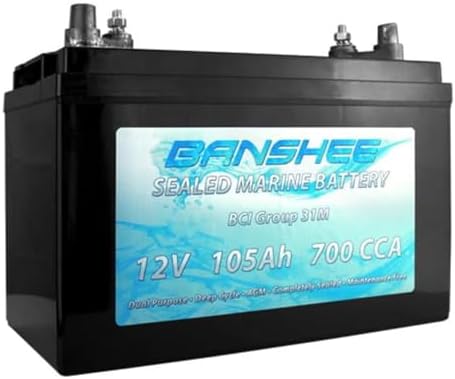
A Group 31 AGM battery is the step up for owners who fish full days, run electronics off the same bank, or want a sealed battery that will not spill in a rough compartment. Check the compartment dimensions and the strap length first, because a Group 31 is noticeably larger than a 27.
Weight Is the Problem, Not Capacity
Lithium is where owners go when the bank has become the heaviest thing on the boat. LiTime, for example, publishes a weight of around twenty two pounds for its Group 31 sized 12V 100Ah trolling motor battery, against a lead acid battery of similar capacity that weighs a multiple of that.

The Battery Needs to Be Secured
Any battery on a boat has to be held down and protected from contact, and a box or tray with a strap is the standard way to do it. Match the box to your group size, since a Group 27 battery does not fit a Group 24 box and a loose battery in an oversized box is worse than no box.

Charging It Properly
Trolling motor batteries need a charger that suits their chemistry, and the setup on a boat with two or three batteries is usually an onboard multi bank charger. Selecting and fitting one is where a marine technician earns their fee, but the charger itself is a normal purchase.

Working Out Runtime Without Guessing
Runtime is capacity divided by draw. Your motor’s manufacturer publishes a maximum amp draw for the model, and battery makers publish amp hour capacity, so dividing one into the other gives you an approximate hours figure at full throttle. Real use is lower than maximum draw, so treat it as a worst case.
Two things push actual runtime below that arithmetic. Lead acid batteries should not routinely be taken to empty, so usable capacity is less than rated capacity, and cold weather reduces available capacity in every chemistry. Buying more amp hours than the math suggests is the normal correction.
Speed Costs More Than You Think
Trolling motor draw rises sharply with speed, so the same battery that lasts a long day at a low setting can be flat in a few hours at full power. Owners who spend their day fighting wind at high settings need considerably more capacity than owners easing along a shoreline.
Spot lock and other holding features also draw power in bursts all day rather than continuously, which is easier on the battery than constant high throttle but still adds up over a long session.
Installation Belongs to a Technician
Wiring a battery or a bank into an existing boat is work for a marine technician, and this guide covers what to buy rather than how to wire it. Cable sizing, fusing, connections to a switch and the layout of a multi battery bank all have consequences that are dangerous to get wrong in a confined, damp space.
What helps is arriving prepared. Measure the compartment, note the existing group size and terminal type, photograph the current setup, and know your motor’s voltage and amp draw. A technician working from that information finishes faster and orders the right parts the first time.
Frequently Asked Questions
What kind of battery do I need for a trolling motor? A deep cycle marine battery matched to your motor’s system voltage. Starting batteries are built for short high current bursts and degrade quickly under the sustained deep discharge a trolling motor produces.
How many batteries does a 24V trolling motor need? Two matched batteries, and a 36V motor needs three. They should be the same type, capacity and age, because a bank performs like its weakest battery.
How long will a trolling motor battery last on the water? Divide the battery’s rated amp hours by your motor’s published maximum amp draw for a worst case figure, then expect less in cold weather and if you avoid fully discharging a lead acid battery. Real runtime depends heavily on the speed setting you use.
Is Group 27 or Group 31 better for a trolling motor? Group 31 generally carries more capacity, so it runs longer, but it is larger and heavier. Group 27 is the common choice because it fits more factory compartments and boxes. Measure the space before deciding.
Can I use a car battery for a trolling motor? An automotive starting battery is the wrong construction for the job and will not last under repeated deep discharge. It is also not built for the vibration and damp of a boat, which is why marine batteries are specified differently.
Should I get AGM or flooded for a trolling motor? AGM is sealed, spill resistant and needs no water top ups, which suits a battery in an awkward compartment. Flooded costs less and performs well if you can reach it to check the electrolyte. Both are valid deep cycle choices.
The Bottom Line
A trolling motor battery is chosen by voltage first, deep cycle construction second, and capacity third, with group size acting as the physical limit on how much capacity you can actually fit. Look up your motor’s published amp draw, compare it to amp hours, then buy more than the arithmetic suggests because cold and usable depth of discharge both work against you. Secure it in a proper box and let a technician handle the wiring. If weight is the sticking point, see our lithium comparison, and for the wider picture the marine battery guide.