Last updated: August 20, 2026
Fender listings are a wall of numbers. A pair of dimensions, a boat length range that may or may not match the one on the next listing, and no explanation of where any of it came from. Meanwhile you are standing in a slip trying to work out whether the fenders that came with the boat are the right ones or the reason there is a scuff along the rubrail.
This page puts the published sizing guidance in one place. Every number here is either the rule Taylor Made publishes in its fender buying guide or the boat length range Taylor Made lists against a specific fender size, so you can check your own boat against something a manufacturer actually stands behind.
This article contains affiliate links. If you buy through them, we may earn a commission at no extra cost to you. Learn more.
Quick Answer
What fender size does your boat need?
- Cylindrical fenders: Taylor Made publishes one inch of diameter for every four to five feet of boat length.
- Round fenders: the same guide calls for two inches of diameter per four to five feet of length.
- Quantity: one fender per 10 feet of waterline per side, minimum three, per Taylor Made.
- Taylor Made describes its chart as a minimum recommendation and suggests checking local conditions with your marina.
Bottom line: the diameter rule gets you close, the model’s own listed length range confirms it.
Diameter Is the Number That Matters
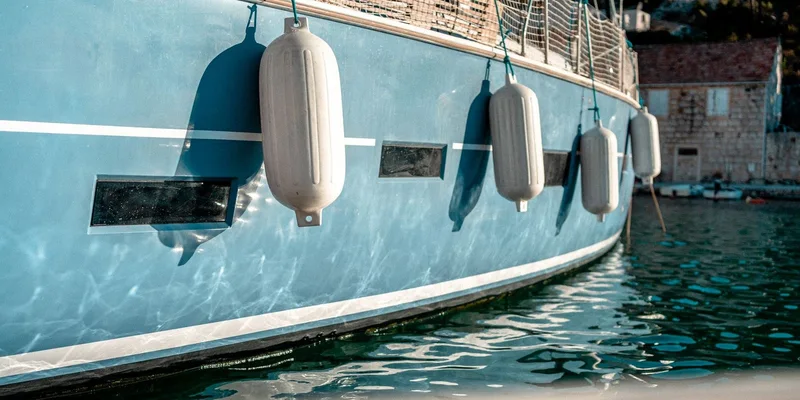
Fenders are sold by diameter and length, and diameter is the one doing the work. It sets how far the fender holds the hull off the dock and how much it can compress before the hull touches anyway. Length spreads that protection over a taller band of topside, which matters but is secondary.
Taylor Made’s published rule is a diameter rule for that reason: one inch of cylindrical fender diameter for every four to five feet of boat length, and two inches for a round fender over the same four to five feet. A short fat fender protects better than a long thin one of the same volume.
Published Fender Sizes by Boat Length
Taylor Made lists boat length ranges against individual fender sizes in its product line, which is the most direct way to check yourself. The table below reproduces published examples from that line so you can see how the diameter rule plays out in real sizes, rather than doing the arithmetic yourself.
| Boat length | Published example size | Fender line | Minimum per side |
|---|---|---|---|
| 15 to 20 ft | 5.5 in diameter by 20 in | Taylor Made Storm Gard | 3 fenders |
| 20 to 25 ft | 6.5 in diameter by 22 in | Taylor Made Super Gard | 3 fenders |
| 25 to 35 ft | 8.5 in diameter by 26 in | Taylor Made Super Gard | 3 to 4 fenders |
| Over 35 ft | Step up per the maker’s chart | Check the model listing | One per 10 ft of waterline |
How to Read the Chart for Your Boat
Take your length overall, apply the one inch per four to five feet rule, and you get a target diameter. Then find a model whose listed boat length range includes your boat. If the two disagree, follow the model listing, because the maker sized that particular fender for that particular range of boats.
Taylor Made is explicit that its chart is a minimum recommendation and advises checking with your marina and docking neighbors so the fenders suit prevailing conditions. That is the sentence to remember if your slip is exposed, if a fairway carries a lot of wake, or if the boat sits unattended for weeks.

When to Go a Size Up
Four situations justify stepping up. An exposed or wake heavy slip, because the load arrives suddenly rather than gently. Rafting up with other boats, because the squeeze is concentrated between two moving hulls. A heavier boat for its length. And a fixed dock with a big tidal range, where the fender has to work over a moving contact height.
Going up a size costs a little more storage space and very little else. Going down a size means the fender compresses flat under load, which is the exact moment it stops doing its job and the rubrail meets the piling.

Fitment Cases the Chart Does Not Cover
Two boat types fall outside a straight length based chart. Pontoons have low freeboard and a rail instead of a hull side, so a fat cylindrical fender often rides above the contact point entirely. Flat fenders that hang over the rail are the usual answer there.
Low Freeboard Aluminum Boats
Same problem, smaller scale. A jon boat or small aluminum fishing boat needs a fender that sits low and does not roll up over the gunwale, which usually means a smaller cylindrical fender hung horizontally or a flat fender.
Boats With a Wide Rubrail
A pronounced rubrail can push a fender outward and let it ride up over the rail under load. Hanging the fender lower so it sits below the rail, or hanging it horizontally, keeps it where the contact happens.
Protecting the Fenders and the Hull
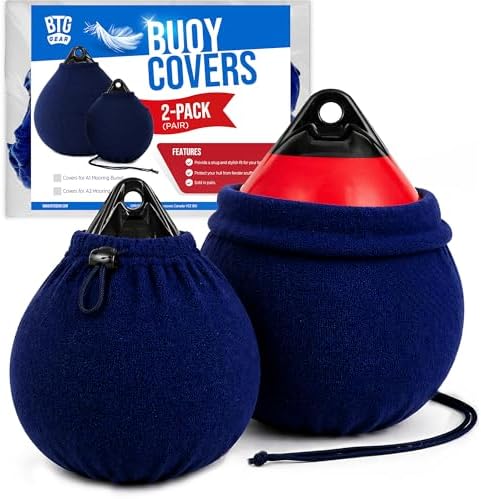
Vinyl fenders collect dock grime and then transfer it to the topsides, so a fender doing its job can still leave a mark. Covers absorb that, wash easily, and cut the squeaking that comes with a boat working in a slip overnight.
Storage matters too. UV exposure chalks and hardens vinyl over seasons, and a hardened fender has lost the compliance you paid for. Deflate what deflates, keep them out of direct sun on the trailer, and check the eyes and seams at the start of each season.
Length as Well as Diameter
The second number in a fender’s dimensions is its length, and it decides how much of the topside is covered rather than how far the hull is held off. A taller boat side, a big tidal range or an uncertain contact height all argue for a longer fender at the same diameter, since a long fender is more forgiving about being hung slightly wrong.
That is why the published sizes step up in both dimensions together. A fender that gets wider without getting longer protects a narrower band, and on a fixed dock where the water moves under you, that narrow band is the thing that ends up in the wrong place at three in the morning.
Frequently Asked Questions
What size fenders for a 24 foot boat? Applying Taylor Made’s rule of one inch of cylindrical diameter per four to five feet gives roughly a five to six inch diameter, and Taylor Made lists a 6.5 inch diameter Super Gard fender for boats in the 20 to 25 foot range.
How many fenders do I need? Taylor Made recommends one fender for every 10 feet of waterline per side, with a minimum of three on even the smallest boats. Add extras for rafting or unfamiliar docks.
Are bigger fenders always better? Bigger fenders protect better and store worse. Since Taylor Made publishes its chart as a minimum, sizing up is the safe direction, limited mainly by where you are going to put them.
Do round and cylindrical fenders size the same way? No. Taylor Made’s guide calls for one inch of diameter per four to five feet for a cylindrical fender and two inches per four to five feet for a round one.
What fender size does a pontoon need? Pontoons are a fitment case rather than a chart case. Low freeboard and a rail mean flat fenders usually contact where a cylindrical fender cannot, regardless of what the length rule suggests.
Should I inflate fenders hard? Follow the maker’s stated pressure. Taylor Made publishes a recommended inflation figure for its inflatable fenders, and over inflating removes the compliance that makes the fender work.
The Bottom Line
Use the published rule to get a target diameter, then confirm against the boat length range listed for the specific fender model, and treat both as minimums rather than targets. Pontoons and low freeboard boats are fitment cases where the shape matters more than the chart. For the wider buying decision see our boat fenders guide, and for keeping them off your gelcoat, the fender holders guide.