Last updated: August 20, 2026
Everybody calls them bumpers. The catalog calls them fenders, and the difference is not just vocabulary: a bumper is fixed to a dock, a fender hangs off your boat and moves with it. Whichever word you use, the two most common mistakes are the same, buying fenders too small for the boat and buying too few of them.
Undersized fenders compress flat under load and let the rubrail kiss the piling anyway, which shows up as a scuff line down one side after a windy night in a slip. This guide covers fender shapes, how manufacturers say to size them, how many you need per side, and how to hang them so they end up where the contact actually happens.
This article contains affiliate links. If you buy through them, we may earn a commission at no extra cost to you. Learn more.
Quick Answer
What size and how many boat fenders do you need?
- Taylor Made publishes the rule most people use: one inch of cylindrical fender diameter for every four to five feet of boat length.
- For round fenders, the same guide calls for two inches of diameter per four to five feet of length.
- Taylor Made also recommends one fender for every 10 feet of waterline per side, with a minimum of three on even the smallest boats.
- Cylindrical fenders suit most slips and pilings; flat fenders suit pontoons and low freeboard boats.
Bottom line: size up rather than down, and carry more fenders than the minimum if you raft up or share a slip.
Fender Shapes and What Each One Is For
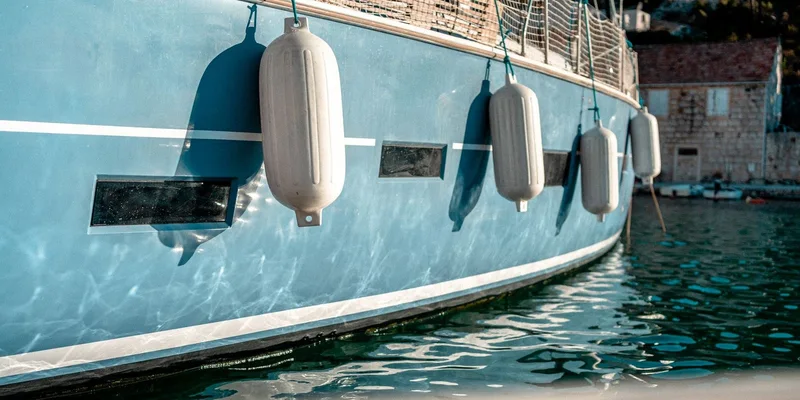
Three shapes cover recreational boats. Cylindrical fenders, the long ones with a rope hole through the middle or an eye at each end, are the default because they hang neatly against a hull side and cover a useful vertical band. They are what you want in a slip and alongside a piling.
Round or ball fenders take the heavy squeeze, which is why they turn up on larger boats, on corners, and between rafted boats where the load is concentrated in one spot. Flat fenders solve the low freeboard problem on pontoons and aluminum boats, where a fat cylinder rides too high to contact anything useful.
Sizing From the Manufacturer’s Rule
Taylor Made’s fender buying guide gives the numbers most boaters work from. For a cylindrical fender, allow one inch of diameter for every four to five feet of boat length. For a round fender, allow two inches of diameter for the same four to five feet. Those are minimums rather than targets.
Taylor Made also states that its published boat size chart is a minimum recommendation and advises checking with your marina and docking neighbors so the protection suits prevailing conditions. In practice that means an exposed slip, a wake heavy fairway or a rafting habit all argue for stepping a size up rather than buying to the line. Our fender size chart lays the published sizes out by length.

How Many Fenders per Side
Taylor Made recommends one fender for every 10 feet of waterline per side, with a minimum of three even on the smallest boats. Three is the practical floor because two fenders leave the boat pivoting on a single contact point when the wind pins it against the dock at an angle.
Count the fenders you need for a normal slip, then decide separately what you carry for the situations you do not plan for. Rafting up, a fuel dock with an unfamiliar piling layout and an emergency tow all want more fenders than a home slip does, and fenders deflate for storage precisely so you can carry extras.
Fender Shapes Compared
| Shape | Best for | Hangs | Watch out for |
|---|---|---|---|
| Cylindrical | Slips, pilings, everyday docking | Vertically or horizontally | Rolling up over a rubrail if hung too high |
| Round or ball | Rafting, corners, heavy squeeze | From a single eye | Bulk when stored inflated |
| Flat | Pontoons, low freeboard hulls | Over a rail or cleat | Less crush depth than a cylinder |
| Fender board | Rough pilings and tidal docks | Across two fenders | Storage space on a small boat |
Hanging Them Where the Contact Happens
A fender only works at the height where the dock or the other boat actually touches. That height changes with tide, with fuel and passenger load, and with whether you are alongside a floating dock or a fixed one, so a set-and-forget height is a fixed dock problem waiting to happen.
Vertical or Horizontal
Vertical is the default and covers a band of hull. Horizontal, hung from two points, works better against a low floating dock edge or when you want the fender to bridge across a piling rather than roll around it. Cylindrical fenders with an eye at each end are built for both.
Tie to the Right Hardware
Fender lines belong on a cleat, a rail or a dedicated fender hanger, not on a lifeline stanchion base or anything structural you would rather not load. A clove hitch finished with two half hitches is the traditional knot because it adjusts easily and does not jam after a night of working.

Covers, Storage and Keeping Your Hull Clean
Bare vinyl fenders pick up dock grime and then rub it into your gelcoat, which is how a fender meant to protect the hull ends up marking it. Fleece or knit fender covers absorb that and are far easier to wash than the topsides, and they quiet the squeaking against the hull at anchor.
For storage, deflate what you can and keep them out of the sun. Vinyl chalks and hardens with UV exposure, and a hardened fender loses the compliance that made it useful. Our fender covers guide goes into materials and fit.
Where Fenders Live on a Trailer Boat
On a boat that goes home on a trailer, fenders have nowhere obvious to live and usually end up rolling around the deck or wedged behind a seat. Deflating them for the drive solves both the storage problem and the habit of leaving them hanging over the side on the highway, which shortens their life and looks like exactly what it is.
Check the eyes and seams at the start of each season while they are deflated. A pulled eye or a split seam is easy to spot on a soft fender and almost impossible to spot on an inflated one, and it is the failure that happens when the fender is under load rather than in the locker.


Frequently Asked Questions
What size fenders do I need for a 20 foot boat? Apply Taylor Made’s published rule of one inch of cylindrical fender diameter per four to five feet of boat length, then check the specific model’s listed boat length range. Taylor Made calls its chart a minimum recommendation.
How many boat fenders should I have? Taylor Made recommends one per 10 feet of waterline per side with a minimum of three. Carry extras beyond that if you raft up or visit unfamiliar docks.
What is the difference between a boat fender and a bumper? A fender hangs from the boat and moves with it. A bumper is fixed to the dock. Most owners use the words interchangeably, and product listings usually cover both terms.
Should fenders hang vertically or horizontally? Vertically for slips and pilings, horizontally when you need to bridge a low dock edge or spread the load. Cylindrical fenders with an eye at each end can do either.
Do I need fender covers? They are not required, but they stop dock grime being rubbed into the gelcoat and reduce squeaking. They are also far cheaper to replace than a topside polish.
What fenders work on a pontoon? Flat fenders, because a pontoon has low freeboard and a rail rather than a hull side to hang from. A cylindrical fender often rides above the actual contact point on a pontoon.
The Bottom Line
Fenders are cheap insurance sized by a published rule: Taylor Made’s one inch of cylindrical diameter per four to five feet of boat length, two inches for a round fender, and one fender per 10 feet of waterline per side with a minimum of three. Buy up rather than down, hang them where the contact actually happens, and put covers on them. Our fender size chart lists the published sizes, and the dock line guide covers the other half of a tidy slip.