Last updated: August 20, 2026
The coiled red cord clipped to the dash is the most ignored safety device on the water. Everybody knows what it does, almost everybody has run without it clipped on, and the reason is always the same: it snags on the wheel, it pulls loose when you reach for the throttle, and it stops the engine at the worst possible moment in a crosswind.
The consequence of not wearing one is the reason it exists. A boat whose operator goes over the side does not stop. It circles, under power, back toward the person in the water. This guide compares the corded lanyard with the newer wireless systems, and explains the federal use requirement with the source so you can check it yourself.
This article contains affiliate links. If you buy through them, we may earn a commission at no extra cost to you. Learn more.
Quick Answer
Should you run a corded lanyard or a wireless kill switch?
- Corded is what came with the boat, costs almost nothing, and works without batteries.
- Wireless removes the tether, so it gets worn on boats where a cord never does.
- Wireless systems need a fob per person and batteries that have to be kept alive.
- The Coast Guard publishes a use requirement for engine cut off switch links at uscgboating.org.
Bottom line: the best kill switch is the one you actually attach, so if the cord stays unclipped on your boat, a wireless system is worth the money.
What the Engine Cut Off Switch Does
An engine cut off switch, abbreviated ECOS, is a switch at the helm or on the tiller that stops the engine when the link connecting it to the operator is pulled free. The Coast Guard describes the link, the ECOSL, as attaching the driver to that switch so the engine shuts down if the driver is displaced from the controls.
The failure it prevents is specific. Without a working cut off, a boat that loses its operator keeps running, often turning back on itself, and the person in the water is directly in the path. That circling behavior is why this device exists as a rule rather than as a recommendation.
The Federal Use Requirement
Since April 2021 there has been a federal requirement covering the use of engine cut off switch links on smaller recreational vessels. The Coast Guard publishes the details, including which vessels and which operating conditions it applies to, in its engine cut off switch material at uscgboating.org.
In broad terms the requirement addresses recreational vessels under a specified length with engines above a small power threshold, and it applies when the boat is operating on plane or above displacement speed with the helm not inside a cabin. The Coast Guard also lists situations where the link is not required, including docking, launching and loading on a trailer, trolling and operating in a no wake zone. Read the current version at uscgboating.org rather than relying on a summary, and check your state’s boating agency for any additional rules.
Corded Lanyards: The Case For and Against
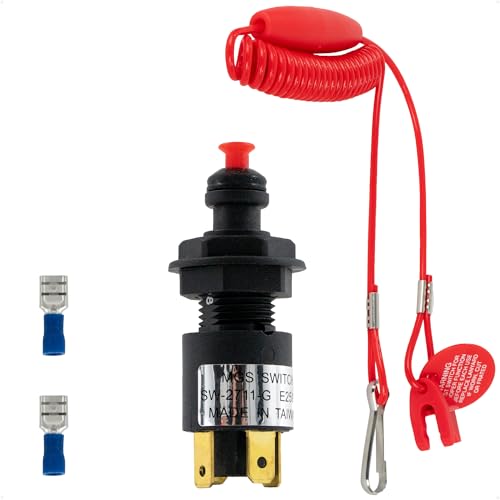
A corded lanyard is a coiled cord with a clip at one end and a key or plug at the other. It is the system every outboard and most sterndrives already have, it needs no power, and a replacement costs less than a tank of fuel. Nothing about it can go flat or lose a pairing.
The objections are practical rather than theoretical. The cord tethers you to one spot at the helm, which is genuinely awkward on a small boat where the operator moves around. It catches on the wheel and the throttle. And on a boat with more than one person who might drive, only the person wearing it is protected, which is the argument that eventually moves most families to wireless.
Wireless Systems: What You Gain and What You Take On
A wireless engine cut off system replaces the cord with a base unit at the helm and a small fob worn by the operator, usually on a wrist strap, a belt clip or a life jacket. If the fob goes in the water or moves out of range, the base cuts the engine. Multiple fobs mean multiple people can be protected, including children and a dog.
The tradeoffs are batteries, pairing and installation. Fobs need charged or fresh batteries, and a dead fob is a system that is not protecting anybody. Wiring a wireless base into an engine circuit is work for a marine technician, so buy on the basis of what the system does and let a professional connect it rather than following a diagram from a forum.
Who Actually Benefits Most
Wireless makes the biggest difference on boats where the operator moves, on tiller steered boats, on small fishing boats where the driver stands, and on any boat where a corded lanyard has spent three seasons hanging unused on the throttle. It is also the option that protects passengers rather than just the driver.
Corded Versus Wireless at a Glance
Neither option is universally better. The comparison below is about how each behaves in normal use rather than about which is technically superior, because the entire value of a cut off switch depends on whether it is being worn.
| Factor | Corded lanyard | Wireless system | Practical effect |
|---|---|---|---|
| Cost | Very low | Considerably higher | Cord is a same day fix |
| Power | None needed | Batteries in fob and base | Wireless needs a routine |
| Freedom of movement | Tethered to the helm | Full movement aboard | Wireless gets worn more |
| People protected | Operator only | Anyone with a paired fob | Matters with kids aboard |
Kill Switch Options by Situation
Three purchases cover almost every owner. Check that a replacement lanyard matches your engine brand and switch pattern, because the key or plug shape is not universal across manufacturers.
Replacing a Missing or Broken Cord
A replacement lanyard matched to your engine is the first purchase if yours has gone missing, and a spare stored on the boat means a lost cord never ends a trip. Confirm the fit for your engine brand before ordering.
Making Sure It Actually Gets Worn
A wireless system with a wearable fob is the answer for anyone who admits the cord stays unclipped. Look at how the fob attaches, since a fob that clips to a life jacket gets worn more reliably than one that lives in a pocket.
Covering More Than the Driver
Systems sold with extra fobs let a second driver, a child or a pet be covered by the same base unit. Count the people on your boat who could go over the side and buy fobs accordingly.
Habits That Make It Work
Attach the link to something that goes with you, not to something that stays with the boat. A belt loop or a life jacket is right. A pocket, a wrist you may pull free of, or a loop over the throttle is not, and neither is the common trick of clipping the cord to the wheel so the engine cannot quit.
Test it once at the start of every season. Run the engine at idle at the dock, pull the link, and confirm the engine actually stops. Switches corrode, contacts stick, and a cut off that does not cut off looks identical to one that works.
Carry a Spare
A lost lanyard strands a boat, which is exactly the situation that tempts people to hot wire around the switch. A spare cord in the glove box costs almost nothing and removes that temptation entirely. Bypassing a cut off switch defeats the only device on the boat designed for this specific accident.
Frequently Asked Questions
Is using a kill switch lanyard required by law? There is a federal use requirement for engine cut off switch links on smaller recreational vessels, in force since April 2021. The vessels, engines and operating conditions it covers are published by the Coast Guard at uscgboating.org, and your state may add rules of its own.
Are wireless kill switches legal? Wireless engine cut off systems are sold and used widely. Because approval details and requirements can change, confirm the current position in the Coast Guard’s engine cut off switch material at uscgboating.org before relying on a particular system for compliance.
Do I need a different lanyard for each engine brand? Often yes. The key or plug shape at the switch end varies between manufacturers, so match the replacement to your engine rather than assuming a universal fit.
Can I install a wireless system myself? Connecting a wireless base into an engine circuit is work for a marine technician. Buy on the basis of features and fob count, and have the connection done professionally.
What happens if the fob battery dies? Behavior varies by system, and some will not allow the engine to run. Check the manufacturer’s documentation, keep spare batteries aboard, and treat battery checks as part of your pre season routine.
Does wearing a lanyard replace a life jacket? No. The cut off switch stops the boat, and the life jacket keeps you afloat until it is back. They address different halves of the same accident, which our life jacket guide covers in detail.
The Bottom Line
Corded lanyards are cheap, reliable and frequently unused, which is the entire argument for going wireless. Pick whichever one you will genuinely attach every trip, carry a spare cord regardless, and test the switch at the start of the season. For where this fits among everything else that belongs aboard, see our boat safety equipment checklist and our guide to required safety gear by boat length.