Last updated: August 20, 2026
Safety gear has a habit of aging quietly. The extinguisher gauge drifts out of the green over a winter, the flares hit their date while nobody is looking, the horn can loses pressure in a hot locker, and the jackets get chalky in the sun. None of it announces itself, and all of it gets discovered on the same morning, usually at the ramp with a line of trucks behind you.
This is a walkthrough of the categories of safety equipment a trailerable boat carries, what to check on each one, and where the actual required quantities come from. Those quantities depend on your boat and your state, so this article points you to the sources rather than giving you a number that would be wrong somewhere.
This article contains affiliate links. If you buy through them, we may earn a commission at no extra cost to you. Learn more.
Quick Answer
What safety equipment should be on a boat?
- Wearable flotation for everyone aboard, plus a throwable where one is required.
- Fire extinguishing equipment, a sound signaling device, and visual distress signals for the water you run.
- Navigation lights that work, a working bilge pump, and ventilation where fuel is enclosed.
- The practical extras: first aid kit, anchor and rode, dock lines, a paddle, and a charged phone or radio.
Bottom line: the categories are stable, the required quantities are not, so confirm yours at uscgboating.org and with your state boating agency before the season starts.
Why This List Has No Numbers In It
What a boat must carry depends on its length, its propulsion, whether it has enclosed fuel or accommodation spaces, and where you are running. On top of that, states add their own requirements. A single number printed on a website is wrong for somebody, and being wrong about this category is expensive.
The federal requirements are published at uscgboating.org, which is also where the Coast Guard explains equipment approval and labeling. Your state boating agency publishes the state layer, including registration display, education card rules and any additional equipment. Between those two you get a list that is correct for your boat instead of approximately correct.
The Free Check Nobody Uses
Vessel safety checks are offered by the Coast Guard Auxiliary and the United States Power Squadrons, at no cost and with no penalty for failing. An examiner walks your boat and tells you exactly what is missing or expired. If reading two agency websites sounds like a chore, book one of these instead and let someone else do the cross referencing.
Flotation: Wearables and the Throwable
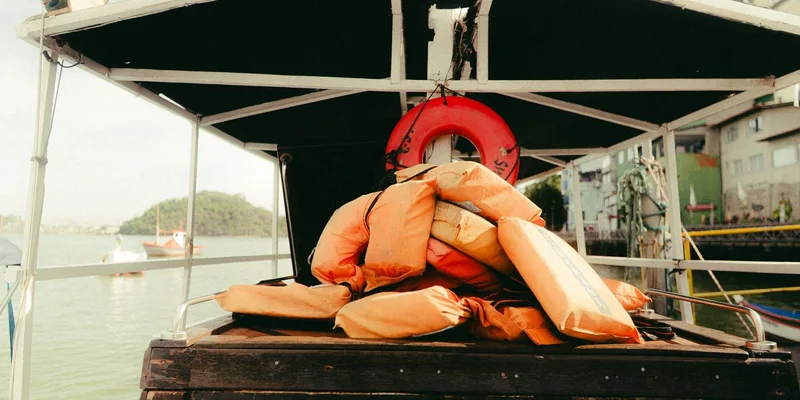
Start here because it is the category most often out of date. Every wearable aboard needs a legible approval label, a wearer range that matches an actual person on the boat, intact fabric and foam, and working buckles. Chalky, torn or waterlogged jackets get replaced rather than kept as spares.
Then check the throwable separately. It should be in the open, reachable from the helm, not doubling as a seat, and paired with floating line if you have added one. Our label guide covers what to look for on the tag, and our throwable guide covers the ring versus cushion decision.
Fire, Sound and Visual Signals
These three categories are what a boarding officer usually asks about after flotation, and all three degrade on a shelf. An extinguisher needs a gauge in the green, an intact pin and seal, and no corrosion at the base. A sound device needs to actually make noise. Signals need to be within their service dates and stowed dry.
Fire Extinguishing Equipment
Marine rated extinguishers are mounted in a bracket where you can reach them without walking past the engine, not left loose in a locker to roll around. Check the gauge, the date, and the bracket itself, since plastic brackets get brittle in the sun. Our marine extinguisher guide covers class ratings and mounting.
Sound and Visual
A sound signaling device covers everything from a bend in a channel to fog, and the practical answer on most trailerable boats is a canned or handheld horn with a backup whistle on each jacket. Visual distress signals have expiration dates and rules that differ by water and by time of day, which are set out at uscgboating.org. Our air horn guide covers the sound side.
The Boat Itself
Equipment gets the attention, but the boat has its own checklist. Navigation lights should light on both settings, not just the ones you use at the ramp. The bilge pump should run and the float switch should lift. Ventilation blowers on boats with enclosed fuel spaces should move air, and hoses should be attached at both ends.
Also check the drain plug, the steering for stiffness or play, the fuel line and primer bulb for cracking, and the battery terminals for corrosion. None of these are safety equipment in the legal sense, and all of them turn a nice day into a tow when they fail.
The Pre Season Check by Category
Run this once in spring and again at midseason. The table lists what to inspect and what usually kills each item, so you know what you are looking for rather than glancing at a locker and calling it done.
| Category | What to check | What usually kills it | Where the rule lives |
|---|---|---|---|
| Wearable flotation | Label legible, fit, fabric, buckles | Sun and being stored wet | uscgboating.org and your state |
| Throwable | Reachable, unoccupied, line coiled | Used as a seat | uscgboating.org |
| Fire extinguisher | Gauge, pin, seal, bracket, date | Vibration and corrosion | uscgboating.org |
| Sound device | Horn fires, whistles attached | Pressure loss in a hot locker | uscgboating.org |
| Visual signals | Service dates, dry stowage | Expiry and moisture | uscgboating.org |
| Lights and pump | All settings, float switch lifts | Corroded grounds and debris | Owner maintenance |
The Extras That Are Not Required
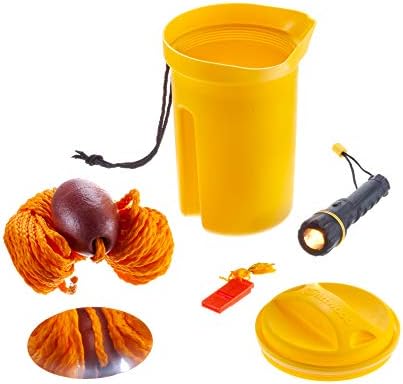
A first aid kit in a dry bag, an anchor with enough rode for where you actually anchor, spare dock lines, a paddle, a bailer, a flashlight, a tool roll and a charged phone in a waterproof pouch. None of these appear on a compliance list, and all of them are what turn a problem into an inconvenience instead of a rescue.
Add a float plan for longer trips, meaning somebody ashore knows where you launched, where you are going and when you expect to be back. It costs one text message and it is the single most useful thing you can do for a search that hopefully never happens.
Keep It Together
Store the small items in one labeled dry bag or bin rather than scattered across three lockers. When a check takes two minutes instead of twenty, it actually happens, and you will not be the person unpacking the whole boat at the ramp looking for a whistle.
Frequently Asked Questions
How many life jackets does my boat need? That depends on your boat and your state, and the requirement is published at uscgboating.org with the state layer at your state boating agency. Both are quick to read and neither charges anything.
Do I need flares on an inland lake? Visual distress signal requirements vary by the water you are on and by time of day. The current rules are at uscgboating.org, and a free vessel safety check will confirm what applies to your boat.
What is a vessel safety check? A free inspection by the Coast Guard Auxiliary or the United States Power Squadrons. There is no penalty for not passing, and you leave knowing exactly what to fix before you are boarded for real.
Does a boat need a first aid kit by law? Generally it is not a listed requirement, which is a poor reason to skip it. A compact marine kit in a dry bag covers the cuts, hooks and sunburn that actually happen aboard.
How often should I check safety gear? Once before the season and once around midsummer. Extinguisher gauges, horn pressure and signal dates are the three that move without anyone touching them.
Do the rules differ by state? Yes. Registration display, boater education cards and some equipment requirements are set at state level, so check your state boating agency alongside the federal list.
The Bottom Line
The categories on a boat safety list barely change from year to year, but the quantities depend on your boat and your state, so get those from uscgboating.org and your state boating agency rather than from a blog. Check flotation, fire, sound and signals in spring, confirm lights and the bilge pump work, and book a free vessel safety check if you want a second pair of eyes. Start with our label reading guide, since flotation is the category that fails quietest.