
Last updated: August 20, 2026
A boat fire is a short story. There is no fire department coming, there is nowhere to walk to, and the fuel is usually right underneath everyone. The extinguisher is the entire response plan, which makes it strange how many boats carry one loose in a locker under a life jacket and a coil of rope.
This guide covers what the rating on a marine extinguisher means, why the mounting bracket is not optional, where on the boat it should live, and what to check every spring. Which rating and how many your boat must carry is a federal and state question, so that part is referenced rather than guessed at here.
This article contains affiliate links. If you buy through them, we may earn a commission at no extra cost to you. Learn more.
Quick Answer
What kind of fire extinguisher does a boat need?
- A marine rated extinguisher with a Coast Guard approval statement, not a spare household unit.
- Class B covers flammable liquids and class C covers electrical, which is the fire a boat actually has.
- It must be in its bracket, mounted where you can reach it without walking toward the engine.
- Check the gauge, the pin, the seal and the date every spring, and after every winter on the trailer.
Bottom line: buy marine rated, mount it properly, and confirm the required rating and quantity for your boat at uscgboating.org.
Why a Household Extinguisher Is the Wrong Tool
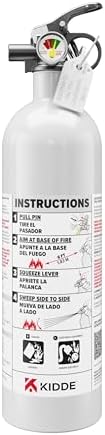
A kitchen extinguisher is built for a kitchen: a dry indoor cabinet, mild temperature swings, no vibration. A boat delivers salt air, constant pounding, heat in a closed locker and moisture year round. Marine rated units are built and approved for that environment, and they carry the approval statement that an inspection is looking for.
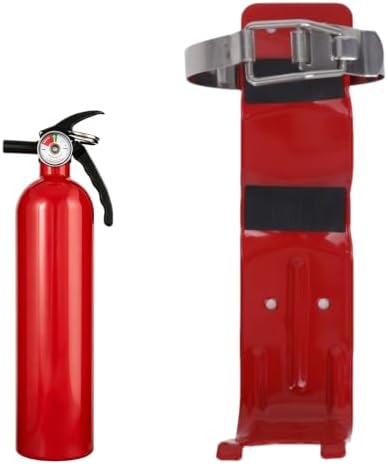
The mounting bracket is part of the difference. A marine bracket holds the unit against vibration and pounding so the powder does not settle into a solid cake at the bottom of the bottle. An extinguisher rolling loose in a locker for two seasons can look perfect on the gauge and discharge almost nothing when you squeeze the handle.
What the Rating on the Label Means
The letters describe the fire and the numbers describe the capacity. Class A is ordinary combustibles like cushions and wood, class B is flammable liquids such as fuel and oil, and class C is energized electrical equipment. A boat fire is usually B, C or both, which is why marine units are commonly rated B:C.
Numbers and the Newer Labels
Older marine extinguishers carried Type B-I and B-II designations, while newer ones show a numeric class rating such as 5-B or 20-B, where the higher number means more capacity. Both styles are on boats right now. Which rating and how many your boat needs depends on its length and construction, and that is published at uscgboating.org.
Dry Chemical, and What It Leaves Behind
Most marine units are dry chemical, which is effective and cheap and leaves a corrosive powder over everything it touches. That is an acceptable trade in an emergency. Clean it up promptly afterward, because the residue is unkind to aluminum, electrical connections and gelcoat if it sits.
Where to Mount It
Mount the extinguisher where you can reach it while moving away from the fire, not toward it. On an outboard runabout that usually means near the helm or just inside the companionway, not in the stern locker beside the fuel tank. You want the unit between you and the exit, always.
Height and orientation matter too. Keep it high enough to stay out of bilge water, in the bracket the manufacturer supplied, with the gauge visible without unclipping anything. If passengers who are not you might have to grab it, put it somewhere obvious rather than somewhere tidy.
A Second Unit Is Cheap Insurance
Even where one is enough to satisfy a requirement, two in separate locations is the sensible layout on anything with a cabin or an enclosed engine space. Fires do not politely start on the accessible side of the boat, and one unit blocked by the fire is the same as no unit at all.
Comparing the Common Marine Options
The table sorts what is actually on the shelf for recreational boats. The right pick depends on the boat, the spaces you are protecting and what your requirement says, which is why the last column points back to the source rather than to a recommendation.
| Option | Covers | Best placed | Notes |
|---|---|---|---|
| Marine B:C dry chemical | Fuel and electrical fires | Helm or companionway bracket | The standard choice on most boats |
| Marine A:B:C dry chemical | Also cushions, canvas and wood | Cabin or main living space | Broader coverage, same residue |
| Compact PWC unit | Small liquid and electrical fires | Jet ski or small tender | Sized for very limited stowage |
| Clean agent unit | Electronics and enclosed spaces | Near sensitive equipment | No powder residue, costs more |
The Spring Check
Four things, two minutes. The gauge needle should sit in the green. The pin should be in place with an intact seal. The body should be free of corrosion, dents and cracked plastic at the neck. The label should be readable, including the approval statement and any date printed by the manufacturer.
For dry chemical units, unclip the extinguisher and invert it a few times so the powder does not stay packed at the bottom. Then look at the bracket itself. Plastic brackets go brittle after a few seasons in the sun, and a broken bracket means the unit is loose again, which is where the whole problem started.
When to Replace It
Replace an extinguisher if the gauge is out of the green, the seal or pin is missing, the body is corroded, the label is unreadable, or it has been discharged even briefly. Disposable units are not worth recharging. Rules about expiration and service intervals for marine units are set out at uscgboating.org, and a free vessel safety check will flag anything that has aged out.
Frequently Asked Questions
How many fire extinguishers does a boat need? It depends on boat length and construction, and on your state. The federal requirement is published at uscgboating.org, and your state boating agency covers any additional rules.
Can I use a household extinguisher on my boat? Not as your required unit. Marine rated extinguishers carry the approval statement and are built for vibration, salt and moisture, which is what a boarding officer and the environment both expect.
Do marine fire extinguishers expire? They age out, and the specifics for marine units are covered at uscgboating.org. Practically, replace any unit with a gauge out of the green, a missing seal, corrosion or an unreadable label.
What does B:C mean? B covers flammable liquids such as fuel and oil, C covers energized electrical equipment. Both are what a boat fire usually involves, which is why B:C is the common marine rating.
Where should the extinguisher be mounted? Somewhere you can reach while moving away from the engine and toward an exit, high enough to stay dry, in its bracket, with the gauge visible without unclipping it.
Should I keep the old one as a spare? Only if it still passes the spring check. An expired or discharged unit stored beside a good one mostly creates confusion in the exact moment you cannot afford it.
The Bottom Line
Buy a marine rated extinguisher with a visible approval statement, mount it in its bracket between you and the exit rather than beside the fuel, and check the gauge, pin, seal and label every spring. Get the required rating and quantity for your specific boat from uscgboating.org and your state boating agency, and treat a second unit as cheap insurance. It belongs alongside the rest of your pre season safety check.