Last updated: August 20, 2026
The throwable is the piece of safety gear most likely to be the wrong shape, in the wrong place, or buried under a cooler. On a lot of boats it is a flat square cushion that somebody has been sitting on since May, wedged under a seat where nobody could reach it in ten seconds. Which is a shame, because it is the one item designed to help someone who is already in the water.
This guide covers the difference between a ring buoy, a horseshoe buoy and a square cushion, how to pick between them for your boat, where to stow one so it is genuinely reachable, and why a throwable is an addition to your wearables rather than a replacement for one.
This article contains affiliate links. If you buy through them, we may earn a commission at no extra cost to you. Learn more.
Quick Answer
Which throwable PFD should you carry?
- Ring buoy: throws the farthest and is easiest to see, but needs deck or rail space.
- Horseshoe buoy: easier for a person in the water to get into, mounts on a rail bracket.
- Square cushion: cheapest and most compact, hardest to throw accurately into wind.
- Add a floating line to whichever you pick, because a throwable you cannot retrieve is a one shot device.
Bottom line: buy the one you can stow within arm’s reach of the helm, and check the requirement for your boat at uscgboating.org.
What a Throwable Is Actually For
A throwable is designed to be thrown to a conscious person already in the water so they have something to hold until the boat can reach them. It is not worn, it is not designed to turn anyone face up, and it does nothing for someone who is unconscious. Its whole job is to give a swimmer buoyancy and a visible point to hold.
That is also the reason it can never stand in for a wearable. A person in the water has to see it, swim to it, and hold on to it, and all three of those things assume they are alert and able. Wearables cover the case where they are not. Our life jacket guide covers the wearable side of the same locker.
Ring, Horseshoe or Cushion
The three shapes solve the same problem differently. A ring is a closed circle that flies well and is easy to spot. A horseshoe is open at one side so a swimmer can get inside it without lifting it over their head. A cushion is a flat square with two webbing straps that doubles as a seat, which is exactly how most of them end up buried.
The Ring Buoy
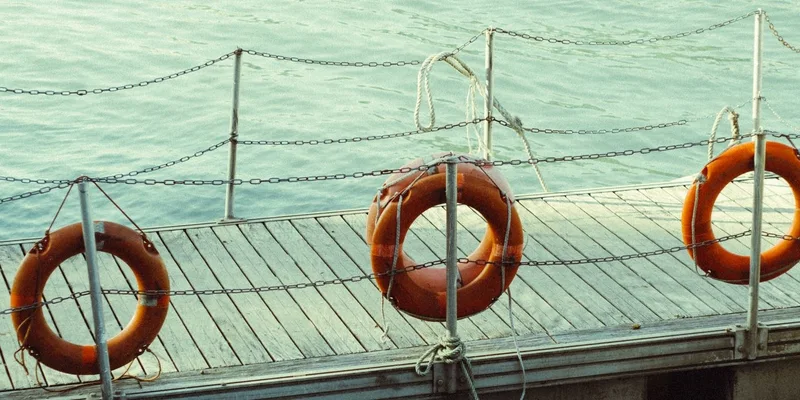
A ring throws the farthest and the straightest, which matters when the swimmer is downwind and drifting. It is the obvious choice on any boat with rail space or a transom bracket, and the traditional white and orange makes it easy to find in chop. Mounting it in the open is the point, not a compromise.

The Horseshoe Buoy
The horseshoe trades a little throwing distance for a shape a tired swimmer can slide into rather than climb over. It stows in a bracket on a rail or a hardtop leg and stays out of the way, which suits boats where deck space is short. It is the common pick on center consoles and larger runabouts.

The Cushion Problem
Square cushions are inexpensive, compact and approved as throwables, and that combination is exactly why so many boats carry one and so few could deploy it. The moment a cushion becomes seating, it stops being safety equipment. If yours lives under somebody, it is not a throwable, it is upholstery.
They also throw badly. A flat panel catches wind, tumbles, and rarely lands where you aimed, especially with a crosswind and an adrenaline throw. On a small jon boat or a tiller skiff where nothing else fits, a cushion is a reasonable answer. On anything with room for a ring or a horseshoe, the better shape is worth the space.
If You Do Carry a Cushion
Keep it clipped where it is visible and unoccupied, ideally near the helm, and replace it when the fabric splits or the foam goes hard. Cushions live a rough life in the sun, and a cracked one is easy to overlook because it still looks like a cushion.

Comparing the Three Shapes
Pick by boat layout first and by throwing distance second, because a throwable stowed badly is worse than a lesser shape stowed well. The comparison below assumes the device carries a valid approval label, which is the baseline for all three.
| Type | Throws | Easy to get into | Stows |
|---|---|---|---|
| Ring buoy | Farthest and straightest | Must be lifted over the head | Rail or transom bracket, in the open |
| Horseshoe buoy | Good, slightly less than a ring | Open side, easiest for a tired swimmer | Bracket on a rail or hardtop leg |
| Square cushion | Poorly, tumbles in wind | Held against the chest by the straps | Anywhere, which is the problem |
| Any of the above with line | Limited by line length | Same as base type | Bag or coil next to the device |
Add a Line, and Stow It Where It Belongs
A throwable without a line is a single attempt. Attach a length of floating polypropylene line, coiled in a bag or a loose figure eight so it pays out cleanly, and you can pull a swimmer to the boat rather than motoring back to them with a spinning propeller. Floating line is the specific requirement here, since sinking line fouls and disappears.
Stowage is the other half. The device should be reachable from the helm without moving anything, in the open, and not doubling as a seat, a footrest or a place for the cooler. On a boat with a rail, a bracket keeps it visible and dry. On an open boat, a clip on the console side works.
What the Rules Say
Whether your boat must carry a throwable, and which boats are exempt, is set by federal rule and by your state. Those requirements are published at uscgboating.org, and your state boating agency lists any additions. Do not take a count from a product listing, and fold the check into your pre season equipment review.
Frequently Asked Questions
What is the main advantage of a Type IV PFD? It can be thrown to someone who is already in the water, which means help reaches them before the boat does. That is the one thing a wearable in a locker cannot do.
Does a throwable count instead of a life jacket? No. Throwables and wearables are separate categories, and the throwable assumes a conscious swimmer who can reach and hold it. Carriage requirements for both are published at uscgboating.org.
Ring or horseshoe for a center console? A horseshoe in a rail bracket is usually the easier fit, since it stows out of the walkway and a tired swimmer can get inside it without lifting it overhead.
How long should the line be? Long enough to reach past where a person would realistically end up astern, and made of floating polypropylene so it stays on the surface. Coil it in a bag next to the device so it deploys without tangling.
Can I use an old cushion that has been sat on all season? Only if the fabric is intact, the foam is still resilient and the label is readable. Compressed or split cushions should be replaced, and the replacement should not live under a passenger.
Where should the throwable be kept? Within arm’s reach of the helm, in the open, and never under gear. A device you have to dig for has already failed the only test that matters.
The Bottom Line
Choose a ring buoy if you have rail or transom space, a horseshoe if you want the shape a tired swimmer can get into, and a cushion only when nothing else fits the boat. Add floating line to whichever you pick, mount it where a hand can find it from the helm, and treat it as an addition to your wearables. For the mounting and sizing side, read our life ring and horseshoe buoy guide.