
Last updated: August 20, 2026
Trailer lights are the only part of a boat trailer that gets deliberately submerged in water while hot. Back the trailer down, the bulbs and housings that have been running for an hour hit cold water, and the pressure difference pulls moisture straight through any gap. That is why incandescent trailer lights on a boat trailer have such a short and frustrating life.
Sealed LED lighting changed that, and it is now the default answer for anything that launches. This guide covers what makes a light genuinely submersible, how to pick a kit that matches your trailer width and connector, and the small habits that keep a good kit working for years rather than one season.
This article contains affiliate links. If you buy through them, we may earn a commission at no extra cost to you. Learn more.
Quick Answer
What should you look for in boat trailer lights?
- Sealed submersible LED, not incandescent. A potted or sealed circuit board is what survives being dunked hot.
- Buy a complete kit with the harness included rather than assembling mismatched parts.
- Check whether your trailer needs the under 80 inch or the over 80 inch version, since wider trailers need extra lamps.
- Match the connector to your tow vehicle, most commonly a flat four pin on a boat trailer.
Bottom line: a sealed LED kit with the right harness length and connector solves the problem that keeps recurring with old bulb lights.
Why LED Replaced Bulbs on Boat Trailers
An incandescent bulb runs hot, and dunking a hot bulb in cool water creates a pressure drop that draws moisture past seals and into the housing. Once water is inside, the contacts corrode and the bulb fails, usually somewhere between the ramp and home. LEDs run far cooler and are typically sealed into the housing rather than replaceable.
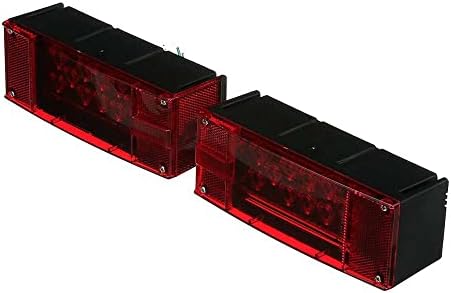
The other advantage is construction. Partsam, for example, describes its submersible rectangular LED trailer lights as using a sealed circuit board so the diodes and board are protected even when the light is underwater. That sealed assembly is the actual feature you are shopping for, more than brightness or shape.
What Submersible Really Means
Submersible is a description of the housing and the electronics, not a promise about the wiring behind them. A sealed lamp with a poorly connected splice a foot up the harness still fails, just somewhere less obvious. Kits that include the harness with sealed connectors avoid the weakest link.
Buy the Kit, Not the Pieces
A complete trailer light kit ships the driver side lamp with license plate illumination, the passenger side lamp, the license plate bracket, a wiring harness of a stated length, and the mounting hardware. Optronics sells kits in exactly that configuration, including a submersible universal mount combination tail light kit with a 25 foot harness and hardware.
Assembling the same result from individual lamps and generic wire usually costs about the same and introduces splices that a factory harness does not have. On a trailer that is submerged repeatedly, every splice is a future failure point, so fewer is better.
Harness Length
Harness length is worth checking against your trailer rather than assuming. A long tongue, a tandem axle, or a boat that needs the lights mounted on a bar behind the transom all eat cable quickly, and running out of harness halfway is how splices appear.
Trailer Width and the Right Kit Version
Lighting kits are sold in under 80 inch and over 80 inch versions because wider trailers require additional lamps beyond the basic tail light pair. Optronics lists both variants for its submersible line. Measure your trailer at its widest point and buy the version that matches rather than the one that is cheaper.
Lighting requirements themselves are set by federal and state rules and can differ depending on where you register and tow. Check your state’s transportation or motor vehicle agency for what applies to you rather than relying on a general summary, and follow the manufacturer’s application notes for the kit.
Trailer Light Picks by Situation
The Straightforward Replacement Kit
For most single axle boat trailers under 80 inches wide, a sealed submersible LED tail light kit with the harness and license bracket included is the whole job in one box.
Wide and Tandem Axle Trailers
Trailers 80 inches wide and over need the kit version with the extra lamps, and a longer harness to reach the back of a tandem setup.

Adding Side Markers and Clearance Lamps
Side marker and clearance lamps are often the pieces that quietly stop working first, and they are sold separately in sealed LED versions that match the main kit.

Connectors and Adapters
A flat four pin is standard on most boat trailers, but tow vehicles vary and adapters are cheap. Buying the correct adapter beats cutting and splicing a connector that came with your kit.

LED Versus Incandescent on a Boat Trailer
| Feature | Sealed LED | Incandescent bulb | Why it matters |
|---|---|---|---|
| Heat at the lamp | Low | High | Hot bulbs draw water in when dunked |
| Serviceability | Sealed unit, replaced whole | Bulb can be swapped | Sealed lasts longer, no socket to corrode |
| Current draw | Low | Higher | Easier on older tow vehicle circuits |
| Typical failure | Harness or ground, not the lamp | Bulb and socket corrosion | Decides where you look when lights die |
Grounds, Corrosion and the Real Cause of Failures
When LED trailer lights stop working, the lamp is usually innocent. The two suspects are the ground connection and the connector at the tow vehicle. A ground that relies on the mounting bolt through a painted or corroded frame works fine when new and intermittently thereafter, which produces the classic symptom of lights that work until you hit a bump.
Kits with a dedicated ground wire back to the connector avoid most of that. Keeping the plug clean and protected with dielectric grease, and rinsing the whole harness after saltwater launches, handles the rest. If the wiring on your trailer is old, brittle or full of previous repairs, replacing the whole harness with the lights is the cheaper path in the end.
When to Hand It to a Shop
A plug-and-play kit on a straightforward trailer is a bolt-on job. If your trailer has surge brake wiring, a converter box, or a tangle of previous modifications, a trailer shop will sort it faster than you will, and correctly wired lighting is not a place to experiment.
Frequently Asked Questions
Are LED trailer lights really submersible? Sealed LED lamps are built for it, with the circuit board sealed inside the housing so water cannot reach the diodes. The part that still needs care is the harness and the ground connection, which is why a complete kit with sealed connectors is the better buy.
Do I need to unplug the trailer lights before launching? With old incandescent lights it was a common habit, because cooling a hot bulb in water pulls moisture in. With sealed LED lamps it matters far less, though unplugging still avoids any risk of a short at the connector while the harness is underwater.
What size trailer light kit do I need? Measure your trailer at its widest point. Kits are sold in under 80 inch and over 80 inch versions, because wider trailers require additional lamps. Check your state’s transportation agency for the requirements that apply where you register and tow.
Why do my trailer lights work sometimes? Intermittent lights almost always mean a bad ground or a dirty connector rather than a failed lamp. Look at the ground path first, then the plug at the tow vehicle, before replacing anything.
Can I mix LED and incandescent lights on one trailer? It works electrically in most cases, but the different current draw can confuse some vehicle bulb-out monitoring systems. Converting the whole trailer at once avoids chasing an odd fault later.
How long should a trailer light harness be? Long enough to reach from the tow vehicle connector to the rearmost lamp with slack for turning, without splices. Kits commonly ship with harnesses around 25 feet, and longer trailers need the extra length rather than an extension.
The Bottom Line
Buy a sealed submersible LED kit with the harness included, match the under or over 80 inch version to your trailer width, and check the connector against your tow vehicle before ordering. When lights fail later, look at the ground and the plug before you blame the lamps. Lights and tires are the two things that strand a boat trailer, so read our guide to boat trailer tires next.