Last updated: August 20, 2026
Pontoon logs go through three stages. New aluminum is bright. After a season or two it dulls to a flat grey as it oxidizes. Then a brown or black band appears along the waterline, made of mineral scale, algae film and whatever your lake contributes, and no amount of soap touches it.
Getting that back to bright is a chemical job rather than a scrubbing job, and the products that do it are acid based for a reason. This guide covers the order of operations, what each product actually removes, and the precautions that keep an aluminum cleaner off your gelcoat, your deck carpet and your skin.
This article contains affiliate links. If you buy through them, we may earn a commission at no extra cost to you. Learn more.
Quick Answer
How do you clean pontoons back to bright aluminum?
- Rinse and wash first, so the acid cleaner works on oxidation rather than on dirt.
- Use an aluminum specific cleaner made for pontoons. General boat soap will not remove oxidation or waterline scale.
- Work in shade on a cool, wet surface, in small sections, and never let the product dry on the metal.
- Wear the protection the label calls for, and rinse everything nearby before and after, including the trailer.
Bottom line: wash, then treat with an aluminum cleaner section by section following its own label, then rinse thoroughly and consider a protectant to slow the next round.
Why Soap Does Not Work on Pontoon Logs
Boat soap lifts loose dirt off a surface. What dulls pontoon logs is not dirt, it is aluminum oxide formed by the metal reacting with air and water, plus mineral scale deposited at the waterline. Both are chemically bonded to the surface, so they need to be dissolved rather than washed away.
That is what aluminum cleaners are for. They are acid based products formulated to strip oxidation and scale off bare aluminum, and they work in seconds rather than minutes. It also explains why they demand respect: anything that dissolves aluminum oxide will happily attack other finishes.
The Stages of a Pontoon Clean
A full toon clean runs in three stages, and skipping one wastes product. Wash removes dirt so the cleaner reaches metal. The acid stage dissolves oxidation and waterline scale. An optional polish or protectant stage slows the return of both. Most owners do the first two every season and the third every few.
| Stage | What it removes | Product type | Watch out for |
|---|---|---|---|
| Wash | Dirt, loose film, pollen | Marine boat soap and a soft brush | Skipping it wastes the cleaner stage |
| Acid clean | Oxidation and waterline scale | Aluminum specific pontoon cleaner | Overspray onto gelcoat, carpet and trim |
| Polish | Remaining haze, restores shine | Aluminum polish, applied by hand or machine | Labor intensive over a long log |
| Protect | Nothing, it slows the next cycle | Aluminum sealer or clear coat product | Needs a genuinely clean, dry surface |
Step by Step on the Logs
Work with the boat on the trailer or on blocks, on a surface where runoff is acceptable, and in shade. Heat and sun make acid cleaners flash off and streak, and a hot log is the hardest surface to work evenly. Early morning on a cloudy day is ideal.
The Sequence
Rinse the whole boat and trailer with fresh water first, wetting everything the product could reach. Wash the logs with marine soap and rinse again. Then apply the aluminum cleaner to one section at a time, following the product’s own directions for dwell time and application method, and rinse that section thoroughly before moving on.
Keep the surface wet throughout, and rinse from the top down so runoff does not dry on cleaned metal. When the whole log is done, give the boat, the trailer and the ground a long final rinse, because residue left on a trailer frame or on brake components is a problem you meet later.
Protection Is Not Optional
Follow the personal protection the product label calls for. These cleaners are acid based, they attack skin and eyes, and the vapor is unpleasant in still air. Chemical resistant gloves, eye protection and working outdoors with airflow are the baseline, and the label may call for more.
Also protect the boat. Wet down gelcoat, painted surfaces, deck carpet, the motor and the trailer before you start, and rinse anything that catches overspray immediately. Aluminum cleaner on a painted trailer frame or on a cover leaves a mark that does not come out.
Products That Do the Work
The Dedicated Pontoon Cleaner
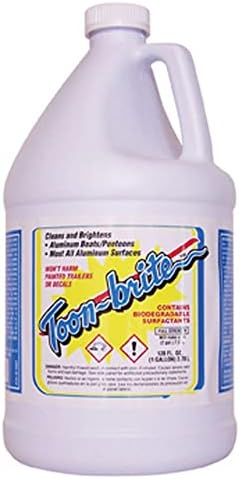
Toon-Brite is the product most pontoon owners are pointed toward, sold as an aluminum cleaner in several sizes and as a kit with a protective clear coat. It is formulated specifically for pontoon logs and waterline stain rather than for general aluminum, which is why it comes up so consistently.
The Widely Stocked Alternative
Star brite’s Ultimate Aluminum Cleaner and Restorer covers the same job for pontoons, jon boats and canoes, and is sold in a bottle with a sprayer that makes working a long log easier. It is a straightforward pick for owners who want one bottle from a brand they already use for other boat cleaners.

The Gear You Need Before You Open the Bottle
Chemical resistant gloves, sealed eye protection and a long handled soft brush turn this from a job you rush into one you can do properly. Buy the protection at the same time as the cleaner, because the temptation to start without it is the reason most people end up regretting the afternoon.

Keeping Them Bright Longer
Oxidation restarts the moment the logs are clean, because bare aluminum reacts with air. What slows it is a sealer or protective coating over properly cleaned metal, plus rinsing the boat with fresh water after each trip, especially in salt or heavily mineralized water.
Rinsing is the habit that does the most and costs nothing. A waterline band builds up over weeks of the boat sitting in the same water, so a boat that gets pulled, rinsed and dried between trips simply never gets to the stage where an acid clean is needed.
Do Not Use These
Pressure washers on high setting can drive water into seams and strip protective coatings, so keep the pressure moderate and the nozzle moving. Steel wool and aggressive abrasive pads leave embedded particles that rust and stain, and household acid cleaners not intended for aluminum can etch the metal permanently.
Gelcoat products do not transfer either. Wax made for a fiberglass hull does nothing useful on bare aluminum, which is a separate material with a separate process. Our boat cleaner guide covers the fiberglass and vinyl side of the same wash day.
Frequently Asked Questions
What is the best cleaner for pontoon boats? An aluminum specific pontoon cleaner such as Toon-Brite or Star brite’s Ultimate Aluminum Cleaner and Restorer. General boat soap removes dirt but not oxidation or waterline scale, which is what actually makes logs look dull.
Can I use vinegar or household cleaners on pontoons? Household products are not formulated for bare aluminum and can etch or stain it, and some are dangerous to mix with anything else on the boat. Stick to a marine aluminum cleaner and follow its own label.
Do I need to acid wash pontoons every year? Only when oxidation or a waterline band has returned. Boats that are rinsed after every trip and stored out of the water often go several seasons between full acid cleans.
Will pontoon cleaner damage my gelcoat or carpet? It can. Wet down gelcoat, paint, carpet, the motor and the trailer before starting, work in small sections, and rinse anything that catches overspray immediately rather than at the end.
Can I pressure wash pontoon logs? Gently. Moderate pressure with the nozzle kept moving is fine for rinsing, but high pressure held in one spot can drive water into seams and damage coatings and decals.
Should I coat pontoons after cleaning? A sealer or protective clear coat over clean, dry aluminum slows the return of oxidation and makes the next wash easier. It has to go on a properly cleaned surface, so it is the last step rather than a shortcut past the first ones.
The Bottom Line
Cleaning pontoons is wash, then acid clean, then protect, done in shade, in sections, on a wet surface, with everything nearby rinsed first. Use a product made for pontoon aluminum, follow its own label rather than a forum recipe, wear the protection it calls for, and rinse the boat and trailer thoroughly afterwards. Then rinse after every trip and you will not need to do the whole job again for years. For the fiberglass and vinyl side see our boat cleaner guide, and for hulls rather than logs the aluminum boat cleaner guide.