
Last updated: August 20, 2026
The moment a boarding ladder matters is the moment you least want to be evaluating it: someone is in the water, the boat is moving in the chop, and the ladder either reaches deep enough to get a foot on a step or it does not. That is why the ladder is worth more thought than its position at the bottom of most accessory lists suggests.
Telescoping ladders solve the storage problem that keeps people from fitting a proper one. They collapse into a fraction of their extended length, mount on the transom or a platform, and stay out of the way until they are needed. This guide covers how many steps you actually need, what the mounting decision involves, and which materials survive.
This article contains affiliate links. If you buy through them, we may earn a commission at no extra cost to you. Learn more.
Quick Answer
How do you choose a telescoping boat ladder?
- Count steps by how far the mounting point sits above the waterline, then add one below the surface.
- At least two steps need to be underwater, or getting back aboard is a pull up rather than a climb.
- Marine grade stainless with wide flat steps beats a thin tubular ladder that cuts into bare feet.
- Decide between transom mount, platform mount and over the gunwale hook before you shop.
Bottom line: buy more steps than you think you need, and check that two of them sit below the waterline when deployed.
How Many Steps You Need
Step count follows freeboard. Measure from the mounting point down to the water with the boat loaded the way you normally run it, then choose a ladder long enough to put at least two steps under the surface. A ladder that stops at the waterline forces a swimmer to haul themselves up on their arms, which is exactly what tires people out.
Three steps suit a low transom on a small aluminum boat or a jon boat. Four steps are the general purpose answer for most runabouts and pontoons. Five steps belong on a high freeboard hull or a boat used by swimmers who need a gentler climb.
Why Underwater Steps Matter So Much
Getting out of the water is a leg powered movement if the ladder is deep enough and an arm powered one if it is not. Anyone who is cold, tired, wearing a life jacket or simply not twenty five any more feels that difference immediately, and it is the single most common complaint about factory ladders.
If your current ladder is short, an extension section or a longer replacement is a cheaper fix than it sounds and it changes the boat’s usability more than most upgrades in this price range.
Mounting Styles Compared
There are three practical ways to attach a boarding ladder. A transom mount bolts through the transom and is the most secure. A platform mount fixes under a swim platform and folds up out of sight. A hook over ladder hangs from the gunwale or platform edge and requires no drilling at all, which makes it the rental and borrowed boat solution.
Permanent mounts are stronger and safer. Hook over ladders are convenient and portable, but they rely on the hook geometry matching your gunwale and they can shift under load, so treat them as a backup rather than a primary boarding route on a boat you own.
| Mount type | Install | Best on | Trade off |
|---|---|---|---|
| Transom mount | Bolts through, backing plate needed | Most runabouts, aluminum boats | Permanent holes in the transom |
| Under platform | Bolts to platform underside | Boats with a swim platform | Needs clearance below the platform |
| Hook over gunwale | None, hangs in place | Borrowed boats, temporary use | Can shift, depends on rail shape |
| Pontoon rail mount | Bolts to the deck gate area | Pontoons and deck boats | Different geometry than a V-hull |
Materials and What Actually Lasts
Marine grade stainless steel is the standard for a reason: it handles salt exposure, takes the load without flexing, and cleans up when it stains. Aluminum ladders are lighter and cost less, and they are fine in fresh water, though they pit faster where salt and dissimilar metals meet.
Step design matters as much as the tube material. Wide flat steps with a molded or textured surface are comfortable on bare feet, while thin round rungs cut into the arch and are genuinely painful when someone is tired and climbing slowly.
Hinges, Pins and the Parts That Seize
The failure point on a telescoping ladder is rarely the tube. It is the pivot, the locking pin or the spring clip, all of which live in salt spray and get used wet. Look for a design where those parts are stainless and accessible, and rinse them with fresh water when you rinse the boat.
A ladder that has seized shut is worse than no ladder at all, because everyone assumes it works. Deploy yours a few times a season even if nobody swims.
Picks by Situation
Standard Transom Fit for a Runabout
A four step stainless telescoping ladder that bolts to the transom covers the majority of trailerable boats. Check the collapsed height against the space you have on the transom before ordering.

Boats With a Swim Platform
Under platform ladders fold up beneath the platform and disappear entirely, which keeps the transom clean and stops the ladder catching lines. Confirm the clearance under your platform first.

No Drilling, No Commitment
A hook over ladder deploys on any suitable gunwale or platform edge with no installation, which suits borrowed boats and second hulls. Check that the hook depth matches your rail thickness.
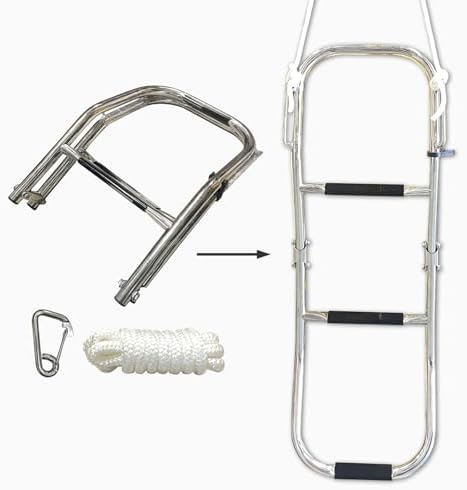
Pontoons and High Decks
Pontoon decks sit higher above the water than most V-hull transoms, so a five step ladder is often the right count. Our pontoon ladder guide covers the gate mounting question specifically.

Installing It Safely
A boarding ladder takes shock loads when a swimmer pulls themselves up in a swell, so mounting hardware needs to spread that load. Use backing plates or oversized washers behind the transom, bed the fasteners in marine sealant so water does not reach the core or the aluminum, and use stainless bolts throughout.
Position matters as much as fastening. Mount it where a swimmer can reach it from the water without swimming under the platform, and clear of the propeller. On an outboard boat that usually means offset to one side rather than dead center.
Before Anyone Swims
Two habits make a ladder work when it counts. Deploy it before people get in the water rather than after, and shut down the engine before anyone goes over the side. Both are ordinary practice on a well run boat and both remove the scenario where a ladder that works fine is not actually down.
Requirements for what you must carry aboard are published by the Coast Guard at uscgboating.org, and state agencies add their own rules. A boarding ladder is a practical necessity rather than something we will quote a federal rule about here.
Frequently Asked Questions
How many steps should a boat ladder have? Enough to put at least two steps below the waterline when deployed. Three steps suit low transoms, four covers most runabouts and pontoons, five suits high freeboard hulls.
Are telescoping ladders strong enough? Quality stainless telescoping ladders carry a published weight rating from the manufacturer, and that rating is the number to check on the listing. Mount it with backing plates so the transom, not the ladder, is not the weak link.
Can I install one without drilling? Yes, with a hook over gunwale ladder. It is convenient but less stable than a bolted mount, so it works best as a backup or on a boat you do not own.
Stainless or aluminum? Stainless in salt water, without question. Aluminum is acceptable in fresh water and lighter to handle, but it pits faster where salt and mixed metals meet.
Where should the ladder be mounted? Somewhere a swimmer can reach from the water without going under the platform, and clear of the propeller. On outboard boats that usually means offset to one side of the transom.
Why does my ladder stick when I try to extend it? Salt and grit in the telescoping sections and the locking pin. Rinse with fresh water and work the ladder through its full travel regularly so it does not seize between uses.
The Bottom Line
Buy the ladder by step count rather than by looks: measure from the mounting point to the water and pick a length that puts two steps under the surface. Stainless tube with wide flat steps, a bolted mount with backing plates, and a rinse habit for the pivot pins will outlast the boat. See the full field in our boat ladder guide, the higher deck version in pontoon ladders, and for getting aboard on the trailer, trailer steps.