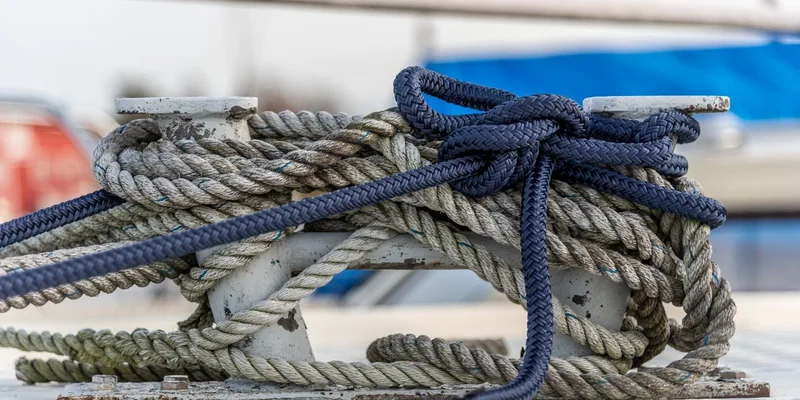
Last updated: August 20, 2026
Dock lines are the cheapest part of the boat and the part most likely to be a collection of mismatched rope that came with three previous owners. One is too short, one is stiff enough to stand up on its own, and one is bright yellow polypropylene from a hardware store, which is the worst possible choice for the job.
Getting this right is not complicated. There are published sizing rules from rope makers and engine manufacturers, there are four line positions that do the actual work, and there is one material that belongs on a boat. This guide covers diameter, length, how many, and what to check before a blow.
This article contains affiliate links. If you buy through them, we may earn a commission at no extra cost to you. Learn more.
Quick Answer
What dock lines does your boat need?
- Nylon, three-strand or double braid. Orion Cordage calls nylon the only acceptable option because its stretch absorbs shock loads.
- Diameter: Orion Cordage publishes one eighth of an inch of diameter per nine feet of boat length, with three eighths of an inch as the minimum.
- Length: bow and stern lines about two thirds of the boat’s overall length, spring lines equal to the boat’s length.
- Quantity: four lines minimum, one bow, one stern and two springs, with six recommended for redundancy.
Bottom line: buy nylon, size from the published chart, and carry spares longer than your everyday set.
Why Nylon and Nothing Else
A dock line is a shock absorber, not just a tether. Every wake, gust and tide change loads the line, and nylon stretches under that load and returns to length afterward. Orion Cordage puts it plainly in its dock line guide, calling nylon the only acceptable option because that elasticity absorbs shock loads.
Polypropylene is the rope to avoid. It floats, which is handy for a tow line and a hazard around a propeller, it has almost no useful stretch, and it degrades quickly in sunlight. The bright yellow rope in the hardware store aisle is exactly this material, which is why it is cheap.
Diameter: Take It From the Chart
Orion Cordage publishes a straightforward formula: use nylon rope sized at one eighth of an inch of diameter per nine feet of boat length, with three eighths of an inch as the minimum for any boat. Its chart then lists a heavier storm diameter alongside the everyday minimum for each length band.
Mercury Marine publishes its own dock line sizing guidance as well, and the two land in the same territory. Where the charts differ slightly, follow the heavier of the two, because rope is the cheapest thing on the dock and the consequences of a parted line are not.
Length: Four Jobs, Two Rules
Bow and stern lines hold the boat in toward the dock. Spring lines run diagonally and stop the boat sliding fore and aft along it, which is the movement that actually chews up rubrails. Orion Cordage’s guidance is that bow and stern lines should be roughly two thirds of the boat’s overall length, and spring lines should equal the boat’s length.
Those are the everyday numbers. For storm preparation, longer is better, since a longer line spreads the same stretch over more rope and reduces the peak load. That is also the reason a spare set that is longer than your everyday set is worth having in a locker rather than a shopping cart in a hurry.

Dock Line Setup at a Glance
| Line | Runs from | Published length guidance | Stops |
|---|---|---|---|
| Bow line | Bow cleat forward to the dock | About two thirds of boat length | Bow swinging out |
| Stern line | Stern cleat aft to the dock | About two thirds of boat length | Stern swinging out |
| Forward spring | Aft cleat forward to the dock | Equal to boat length | Boat sliding aft |
| Aft spring | Bow cleat aft to the dock | Equal to boat length | Boat sliding forward |
Three-Strand or Double Braid
Both are nylon and both work. Three-strand twisted is the traditional choice, stretches generously, splices easily and costs less per foot. Double braid is smoother in the hand, coils neatly, and resists snagging, which matters if you handle lines often or care what the slip looks like.
Eye Splices
Pre-spliced eyes at one end make docking faster: drop the eye over the dock cleat, adjust from the boat. Buy the eye length to suit your cleats, since a small eye that will not pass over a big dock cleat horn is an annoyance every single time you tie up.
Chafe Protection
Wherever a line crosses a chock, a rail edge or a rough piling, it wears. A chafe guard or a length of split hose at that point costs almost nothing and prevents the failure that always happens overnight in a blow rather than on a calm afternoon.


Snubbers, Bungee Lines and Trailer Boats
If your slip is choppy or exposed to wake, a snubber or a bungee style dock line takes the snatch out of the system, letting the boat surge without loading the cleats hard. They are not a substitute for correctly sized nylon, they are a supplement to it, and our bungee dock line guide covers the tradeoffs.
Trailer boat owners need a smaller set than slip owners but should still carry it. Four lines in a locker cover a fuel dock, a launch ramp courtesy dock and an unplanned overnight stop, and they cost less than one gelcoat repair on a corner that met a piling.
Color, Marking and Keeping the Set Together
Buying the whole set in one color and one diameter sounds cosmetic and turns out to be practical, because it means any line in the locker will do any job and nobody has to work out which rope is the short one in the dark. Whipping the ends or using heat sealed ends keeps three-strand nylon from unlaying over a season.
Mark the spring lines if they are cut longer than the bow and stern lines. A wrap of colored whipping twine at the eye is enough, and it saves the routine of pulling out every line to find the long pair when the wind is already pushing you off the dock.

Frequently Asked Questions
What size dock line for a 22 foot boat? Orion Cordage’s formula of one eighth of an inch per nine feet with a three eighths of an inch minimum puts a boat in that range at three eighths of an inch for everyday use, with a heavier diameter listed for storm conditions.
How long should dock lines be? Orion Cordage recommends bow and stern lines at about two thirds of the boat’s overall length, and spring lines equal to the boat’s length. Longer lines are better for storm preparation.
How many dock lines do I need? Four is the working minimum, one bow, one stern and two springs. Orion Cordage recommends six for redundancy, which also covers you when one line is being used somewhere else.
Should I use three-strand or double braid? Both are fine in nylon. Three-strand stretches well, splices easily and costs less. Double braid handles more comfortably and looks neater, at a higher price per foot.
Can I use dock lines as anchor line? Not really. Dock lines are cut for docking lengths and are far too short to give an anchor the scope it needs. See our anchor rode guide for what to buy instead.
When should I replace dock lines? When the rope stiffens, fuzzes heavily, or shows a glazed or flattened section from chafe. Nylon loses stretch as it ages, and stretch is the whole point.
The Bottom Line
Buy nylon, size the diameter from a published chart rather than by eye, and cut the lengths to the two rules: about two thirds of boat length for bow and stern lines, and the full boat length for springs. Four lines minimum, six if you want redundancy, plus chafe guards wherever rope meets a hard edge. Pair them with correctly sized fenders, and our docking guide covers how to actually use the things.