Last updated: August 20, 2026
If you own a bowrider, a center console or an aluminum fishing boat, there is a very good chance the anchor in your locker is a fluke anchor, and an equally good chance nobody ever told you what size it should be. Most boats leave the dealer with whatever hook fit the compartment, and the owner finds out it was undersized on the first breezy afternoon.
This guide covers the fluke anchor specifically: how the shape works, where it belongs and where it does not, how to size one from a published manufacturer table instead of a guess, and what else has to be right before the anchor gets a fair chance to hold.
This article contains affiliate links. If you buy through them, we may earn a commission at no extra cost to you. Learn more.
Quick Answer
Is a fluke anchor the right anchor for your boat?
- Yes if you anchor mostly on sand or firm mud, which covers most lakes, bays and coastal flats.
- Yes if locker space is tight, since a fluke folds flatter than any plow or claw.
- No if your usual spot is rock, rubble or heavy weed, where the plates ride over the top instead of digging in.
- Size it from the maker’s own chart by boat length, and step up if your boat is heavy for its length.
Bottom line: the fluke is the most efficient anchor there is in sand, and close to useless on hard bottoms.
How a Fluke Anchor Sets
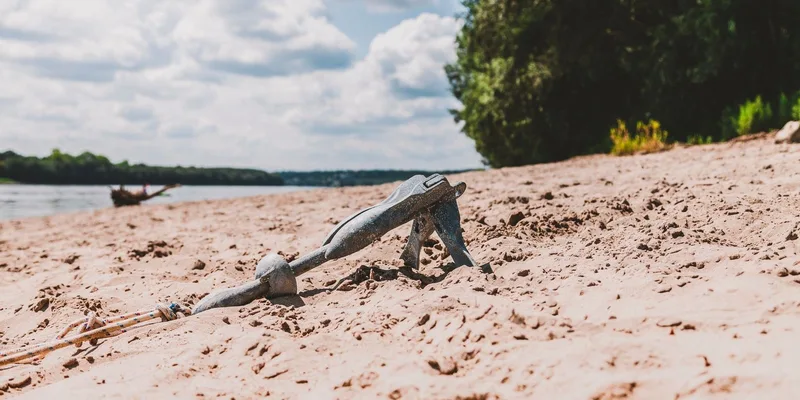
A fluke anchor is two flat triangular plates hinged to a shank, with a stock across the crown that keeps it from rolling. When the rode pulls horizontally along the bottom, the plates tip down, catch the surface and drag themselves under, packing sand or mud on top as they go. The holding power comes from that packed material, not from the weight of the anchor.
That is why a fluke is so light for what it does. It is also why the setting technique matters more than with a heavy anchor: drop it, let the boat drift back, and pay out line steadily so the rode lies along the bottom rather than piling on top of the anchor. Backing down gently on it once it bites confirms the set.
Galvanized or Aluminum
Galvanized steel is the working standard. It costs the least, it takes abuse, and losing one to a snagged bottom is annoying rather than painful. Aluminum fluke anchors are the specialist option, considerably lighter for the same rated holding power, which matters if you retrieve by hand from a small bow or watch every pound on a light boat.
Galvanized Fluke Anchors
The default for trailer boats. Hot dip galvanizing is what protects the steel, so inspect the coating rather than the shine, and expect a galvanized anchor to stain and dull long before it loses strength. Rinse it after salt water and it will outlast several sets of rope.

Aluminum Fluke Anchors
Lighter to handle and lighter in the locker, with adjustable fluke angles on some models so the anchor can be set up for soft mud instead of sand. Fortress publishes a selection guide that pairs each of its aluminum models with a boat length range, which makes sizing straightforward.

Sizing a Fluke Anchor by Boat Length
Use the manufacturer’s chart, because every maker rates its own anchors differently. Fortress publishes a selection guide that lists its FX-7 for boats of roughly 16 to 27 feet, the FX-11 for about 28 to 32 feet, and the FX-16 for about 33 to 38 feet, stepping up from there by length.
Read the conditions those numbers assume. Fortress states that its recommendations are based on average windage and proportions, around 30 knots of wind and moderate protection from open seas, and it advises going one or two sizes larger for storm conditions. A boat with a lot of side area, a tall tower or heavy displacement for its length belongs at the top of its band or in the next one up.
Fluke Anchor Options Compared
| Option | Handling weight | Best use | Watch out for |
|---|---|---|---|
| Galvanized fluke | Heavier for the hold | Everyday trailer boat anchor | Coating wear at the shank |
| Aluminum fluke | Notably lighter | Hand retrieval, light boats | Costs more, softer material |
| Adjustable fluke angle | Same as base model | Switching between sand and soft mud | Only useful if you actually reset it |
| Anchor with rode kit | Depends on model | First anchor, replacing everything | Kit rope sized for the smallest boat |
The Rode Decides Whether It Works
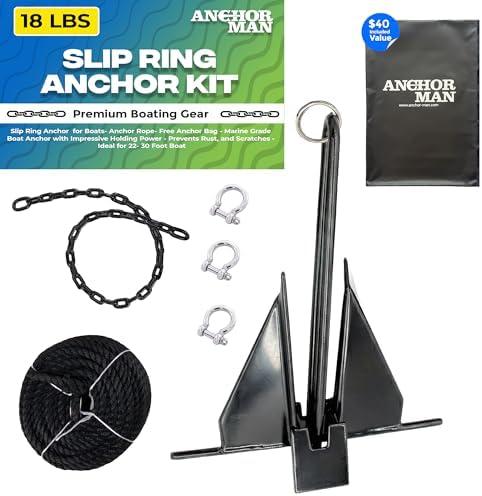
A fluke needs a low pull angle more than most anchors, because the plates only tip and dig when the load runs along the bottom. Fortress publishes its own rode guidance: three-strand nylon, six to twelve feet of chain, a minimum scope of five to one, and at least six feet of chain for every 25 feet of water depth.
Skipping the chain is the most common shortcut and the most damaging one. The chain holds the last stretch of rode down on the bottom, absorbs the shock of the boat rising on a wake, and takes the abrasion where the line drags. Our rope and rode guide covers length and diameter in detail.
Connections and Retrieval
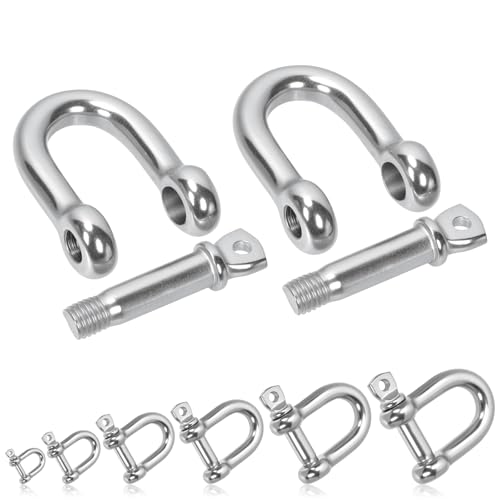
The weak point of most anchor setups is the shackle, not the anchor. Use a shackle rated for the job, seize the pin with wire or a cable tie so it cannot back out under repeated load, and check it at the start of every season. A pin that unthreads over a summer of vibration is a common way to lose an anchor.
For retrieval, motor slowly up over the anchor and pull straight up rather than hauling against the set from behind the boat. If a fluke is genuinely stuck under structure, a trip line rigged to the crown before you drop is the civilized way out, and it saves cutting the rode.
Frequently Asked Questions
What size fluke anchor do I need? Take it from the manufacturer’s chart. Fortress publishes a selection guide by boat length, listing the FX-7 for roughly 16 to 27 foot boats and stepping up from there, with advice to size up for heavier boats and rougher conditions.
Is a Danforth anchor the same as a fluke anchor? Effectively yes. Danforth is the brand that popularized the design, and the name became shorthand for the shape. Anchors sold as Danforth style are fluke anchors from other makers.
Why does my fluke anchor keep dragging? Usually one of three things: not enough scope, no chain at the anchor end, or a bottom the fluke cannot bury in such as rock or thick weed. Check the amount of line out before assuming the anchor is undersized.
Can I use a fluke anchor on a pontoon? You can, but a pontoon swings broadside in wind and a fluke can pull out when the load direction changes. Many pontoon owners prefer a box anchor for that reason, which our box anchor guide covers.
Do I need two anchors? If you anchor on more than one type of bottom, a second hook of a different shape is more useful than a bigger fluke. It also gives you a backup if the first anchor gets fouled and has to be abandoned.
How do I stop the anchor from rattling in the locker? An anchor bag or a chock keeps a galvanized anchor from banging against the hull liner. It also keeps the chain from marking gelcoat, which is the more expensive kind of damage.
The Bottom Line
A fluke anchor is the right choice for the majority of trailerable boats because most of them anchor on sand or firm mud, and no other shape gives that much holding power for that little weight and locker space. Size it from the maker’s published chart rather than by feel, give it chain and scope, and check the shackle every season. For the wider comparison, see our boat anchor buying guide and the anchor types explainer.