Last updated: August 20, 2026
Nobody buys a battery charger because they want one. You buy one because you got tired of hauling batteries out of the boat, up the driveway and onto a bench charger, and then hauling them back down again on Friday night with your back complaining the whole way.
An onboard charger fixes that by living in the boat and waking up whenever you plug in a shore cord. The choices come down to how many batteries you have, how quickly you want them full, and which chemistry is in them. Get those three right and the rest is mounting, which is not your job.
This article contains affiliate links. If you buy through them, we may earn a commission at no extra cost to you. Learn more.
Quick Answer
Which onboard boat battery charger should you buy?
- One bank per battery, always. A three battery boat needs a three bank charger.
- More amps per bank means shorter charge time, and that is the main thing extra money buys.
- The charger must have a profile for your chemistry: flooded, AGM, gel or lithium.
- Look for a sealed, waterproof rated case, because it lives in a wet compartment.
Bottom line: count your batteries, pick that many banks, then buy as many amps per bank as your overnight window needs.
Banks: The First and Most Important Number
A bank is an independent charging output. Each battery on the boat needs its own bank, so a boat with a starting battery and two trolling batteries needs three. Charging batteries individually is what keeps a series or parallel bank balanced and stops a weak battery from dragging the good ones down.
Counting is where owners go wrong. Count physical batteries, not systems. A 24 volt trolling setup is two batteries and therefore two banks, even though the motor sees it as one supply. Add the cranking battery and you are at three.
Buying a Bank You Do Not Need Yet
If you are likely to add a battery within a season or two, buying the extra bank now is cheaper than replacing the charger later. An unused bank does nothing and costs nothing to leave idle, which makes it the rare upgrade that ages well.
Amps Per Bank: How Fast Is Fast Enough
Amps per bank determine charge time. A low output bank can take most of a night to bring a large deep cycle battery back up, while a higher output bank does it in a fraction of the time. The right answer depends entirely on how long the boat sits plugged in between trips.
If the boat lives on a trailer at home and gets plugged in every Sunday, a modest output is fine. If you fish tournaments, dock overnight and go again at dawn, or run high capacity batteries, buy the amps. That is the single spec worth paying up for.
Matching the Charger to Your Chemistry
Flooded, AGM, gel and lithium all want different charge voltages and finishing behavior, and using the wrong profile shortens battery life. Most current marine chargers offer a selector or an automatic detection routine, and confirming yours covers your chemistry is a two minute check that saves a battery.
This matters most for lithium. Lead acid profiles can leave lithium batteries improperly charged and can conflict with the battery’s own management system. If your bank is lithium, buy a charger that names lithium support explicitly rather than one that merely does not exclude it. Our deep cycle chemistry guide covers what each type wants.
Choosing by Bank Count
Here is how the common boat setups map to chargers. Pick the row that matches the batteries actually aboard, then decide how many amps per bank your schedule needs.
| Banks | Typical boat | Charges | Watch for |
|---|---|---|---|
| One bank | Jon boat, small aluminum | Single deep cycle or cranking battery | Outgrown quickly if you add a battery |
| Two bank | 24V trolling plus shore power | A matched pair, individually | Leaves nothing for a cranking battery |
| Three bank | Bass boat, larger fishing rig | 24V pair plus starting battery | Check compartment space for the case |
| Portable | Any boat, off season | One battery at a time on the bench | Means handling batteries again |
Single Bank Setups
A one bank onboard charger suits a small boat with a single deep cycle battery, and it is the cheapest way to stop carrying batteries around. Mount it somewhere dry and reachable, plug in when the boat comes home, and the battery is ready without a thought.
The main caution is future proofing. Owners who add a second battery six months later end up buying twice, so if a second battery is on the horizon at all, look at the two bank option first.

Two and Three Bank Setups
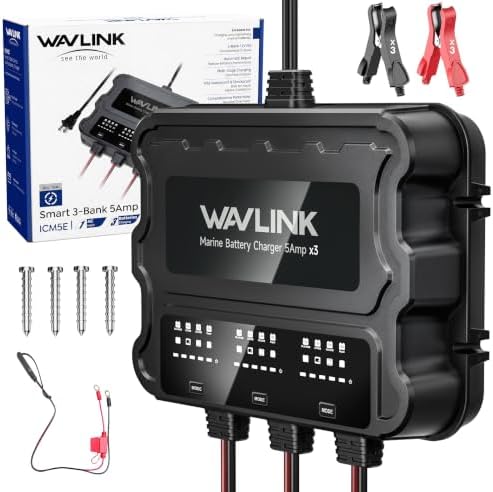
Two bank chargers serve a 24 volt trolling pair, charging each battery separately so the bank stays balanced. Three bank chargers add the cranking battery, which is the standard fit on bass boats and larger fishing rigs and the configuration most owners eventually land on.
Check the physical size before buying. Higher output chargers with more banks are larger and heavier than owners expect, and the mounting location needs to be dry, ventilated and accessible. Fitting and connecting one is work for a marine technician, not a driveway project.

Portable Chargers and Maintainers
A portable charger or maintainer still earns a place even if you fit an onboard unit. It handles the battery you pulled for winter storage, the neighbor’s boat, the trailer battery and the lawn tractor, and it gives you a way to revive a battery that has been sitting.
For a boat that stays on a lift or a mooring without shore power, a small solar maintainer covers the slow self discharge instead. Our guide to solar trickle chargers covers when that makes more sense than dragging an extension cord down the dock.

Mounting and Wiring Belong to a Technician
Choosing the charger is a buying decision. Mounting it, sizing the cable and circuit protection and connecting it to the bank is wiring work in a wet, vibrating environment, and that belongs with a marine technician or a dealer. This guide covers what to buy, not how to wire it.
What you can do yourself is prepare: confirm the mounting space, check the chemistry setting matches your batteries, and make sure the shore cord reaches without lying in bilge water. Those three checks make the technician’s visit shorter.
Frequently Asked Questions
How many banks do I need on a boat charger? One per physical battery. A 24 volt trolling setup with a separate cranking battery is three batteries and therefore a three bank charger, even though the trolling motor treats its pair as a single supply.
Can I leave an onboard charger plugged in all the time? Modern marine chargers are designed to switch to a maintenance mode once the batteries are full, so leaving them connected is normal practice. Confirm your specific model states that, and never leave an older manual charger connected unattended.
What amps per bank should I look for? Enough to refill your batteries in the time the boat sits between trips. Weekend boaters with an overnight window can use a modest output; anglers turning the boat around quickly or running high capacity batteries should buy more amps.
Will a car battery charger work on a boat? On the bench, for one battery, sometimes. As an onboard solution, no. Automotive chargers are not built for the moisture, vibration and multi bank duty a boat demands, and they rarely carry a marine waterproof rating.
Do I need a different charger for lithium batteries? Yes. Lithium needs a charge profile made for it, and a lead acid profile can leave the pack improperly charged. Buy a charger that names lithium support explicitly and set it correctly before the first charge.
The Bottom Line
Count the batteries, buy that many banks, then spend on amps per bank according to how fast you need the boat ready, and confirm the chemistry setting before the first charge. Leave mounting and wiring to a marine technician. From here, the trolling motor battery guide covers capacity, and the solar maintainer guide handles boats without shore power.