Last updated: August 20, 2026
If you have a dock and a pontoon, this argument comes up every spring. One neighbor swears by the lift and points at his tubes, which still look new. The other backs down the ramp every weekend, keeps the boat in the garage all winter and points out that he never paid for a lift, a canopy or the crane that puts them in and takes them out.
Both are right about their own situation, because the decision is not really about money. It is about how often you use the boat, how far you are from the water, whether your lake drops in late summer, and how much you care about oxidation on aluminum that spends five months submerged.
This article contains affiliate links. If you buy through them, we may earn a commission at no extra cost to you. Learn more.
Quick Answer
Should you keep a pontoon on a lift or a trailer?
- A lift wins if you have your own dock and boat often, because it keeps the tubes out of the water between trips.
- A trailer wins if you use different lakes, store at home, or want the boat where you can work on it.
- A lift is the bigger up front commitment, plus a canopy, and it still needs seasonal install and removal on most lakes.
- A pontoon left floating all season is the setup that costs you the most in oxidation and growth on the toons.
Bottom line: choose a lift for one lake and frequent use, a trailer for flexibility, and avoid leaving the boat floating for months either way.
What a Lift Actually Solves
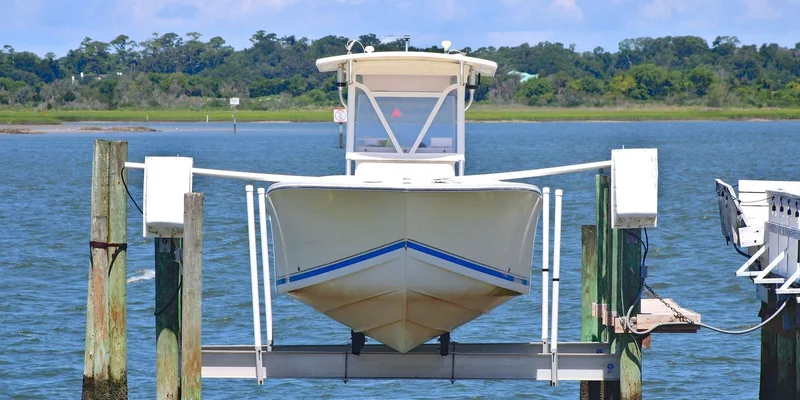
A lift solves one problem completely: it gets the tubes out of the water when you are not using the boat. That stops algae and slime from establishing, slows the mineral scale and oxidation that dull aluminum, and removes the risk of the boat working against dock bumpers in wind or wake. Everything else it does is convenience.
The convenience is real, though. Walking down, dropping the boat and leaving takes minutes rather than the launch and retrieve cycle, and that difference decides how often a boat gets used. Owners who switch from trailering to a lift almost always report using the boat more, which is the actual return on the investment.
Cantilever, Vertical and Floating
Cantilever lifts use a scissor mechanism and suit stable, moderate depth water. Vertical lifts raise the cradle straight up and handle deeper water and fluctuating levels better. Floating lifts use buoyancy chambers and work where the bottom is soft or the depth changes a lot. Which one fits is a question for a local dealer who knows your lake bed, not something to decide from a spec sheet.
What a Trailer Actually Solves
A trailer solves access and control. The boat comes home, sits where you can wash it, work on it and lock it, and goes to whichever water you feel like this weekend. For anyone who fishes more than one lake or takes the boat on vacation, that flexibility is not something a lift can replace.
It also keeps your options open. Trailered boats are easier to sell, easier to service and simpler to winterize, because you are not scheduling a crane or a lift removal around the first freeze. The cost is your time on both ends of every trip, plus a tow vehicle that can genuinely handle a pontoon.
Pontoons Are Not Light
Pontoon trailers are wide, long and heavier than owners expect once the boat, fuel, furniture and gear are on them. Before assuming your vehicle tows it, check the boat and trailer weight against your tow rating rather than guessing. Our breakdown of what a pontoon weighs in practice covers where the mass actually sits.
The Cost Picture Without the Sticker Shock
A lift is a larger initial outlay than a trailer of similar quality, and it rarely ends there. Most owners add a canopy for sun protection, and on lakes that freeze the lift has to be installed each spring and pulled each fall, which is either a yearly service charge or a job you take on yourself.
A trailer costs less to start with but keeps costing in smaller ways: bearings, tires, lights that live underwater twice a weekend, straps, and fuel for every trip. Neither option is free, and the honest comparison is not lift versus trailer but lift plus canopy plus seasonal service versus trailer plus maintenance plus your Saturday mornings.
Lift or Trailer at a Glance
The table below lines up the four questions that actually decide it for most pontoon owners. If three of the four point the same direction, you have your answer without needing to run the numbers any further.
| Factor | Boat lift | Trailer | Who it favors |
|---|---|---|---|
| Tube condition | Best, boat sits dry between trips | Also good, boat leaves the water | Both beat floating all season |
| Time per outing | Minutes to launch and return | Ramp, rigging and retrieve each way | Lift, clearly |
| Flexibility | One dock, one body of water | Any ramp you can reach | Trailer |
| Seasonal work | Install and removal each year | Bearings, tires, lights, straps | Depends on your winter |
Hull and Toon Wear: The Part Owners Underestimate
Aluminum tubes that stay submerged develop growth and a dull, chalky oxidation that gets harder to remove the longer it sits. Boats on a lift skip nearly all of it. Trailered boats do too, provided the tubes get rinsed rather than left with lake water drying on them in the sun.
The setup that costs the most is a pontoon tied to a dock and left floating from May to October. If that is your only option, budget for an annual acid based cleaning session and check the tubes at haul out rather than at the following spring launch, when the deposits have had a whole winter to set.
If You Choose the Lift: The Canopy Question
A lift keeps the tubes dry but does nothing about sun. Furniture vinyl, carpet and the helm take the worst of it, and a canopy over the lift is the standard answer. It also lets you skip wrestling a cover on and off every time, though most owners still cover the boat for extended absences and storms.
Canopy fabric is a consumable. Covers and canopies fade, seams let go and the frame needs the same rinse as everything else, so plan on replacing the fabric well before the structure. A replacement canopy cover sized to your lift frame is a straightforward buy once you know the frame dimensions.
If You Choose the Trailer: Load It Straight
Pontoons load differently from V hulls because there is no keel to center the boat. Without guides, you are lining up two or three tubes onto bunks by eye, in current, usually with a line of trucks behind you. Bunk mounted guides fix that, and they are the single upgrade that turns solo pontoon loading from stressful into routine.
Guides also protect the boat and the trailer when a crosswind pushes the bow off line halfway up the bunks. Our guide to pontoon trailer guides covers the mounting styles and how tall to go for your tube height.

Frequently Asked Questions
Is a boat lift worth it for a pontoon? If you own the dock and use the boat regularly, yes. It keeps the tubes out of the water, removes the ramp from every outing and reliably increases how often the boat gets used. If you visit different lakes or store away from the water, a trailer serves you better.
Can I leave a pontoon on a lift all winter? That depends entirely on your lake and your lift design. Many lakes that freeze require lifts to be removed, and ice movement can destroy a lift left in place. Ask your lift dealer and your lake association rather than assuming, and store the battery ashore either way.
Does a pontoon need a special trailer? Yes. Pontoon trailers use bunks positioned under the tubes rather than a V shaped keel support, and they are wider than a comparable V hull trailer. A standard boat trailer will not support the toons correctly, whatever the length rating says.
How much does a boat lift cost? That varies too much by lift type, capacity, water depth and region to be useful as a single figure, and installation is quoted locally. Get quotes from a dealer who has seen your dock, and include the canopy and the seasonal install and removal in the comparison.
Do I still need a cover if the boat is on a lift? Under a canopy you can often skip the cover for short gaps, but a cover still earns its place for storms, pollen season and any absence longer than a week. A canopy stops most sun and rain, not wind driven debris or nesting birds.
The Bottom Line
One lake and your own dock points to a lift, several lakes or storage at home points to a trailer, and the setup to avoid is leaving the boat floating all season regardless of which you choose. If a trailer is the answer, guides make solo loading manageable, and if the boat is staying on the water, a properly sized pontoon cover is the next thing to get right.