Last updated: August 20, 2026
Spend ten minutes on a pontoon dealer’s lot and you will hear toons, tubes, tritoons, logs, strakes, fence height and a dozen other words used as if everyone already knows them. Most first time buyers nod along and go home unsure whether they were told something important or sold something optional.
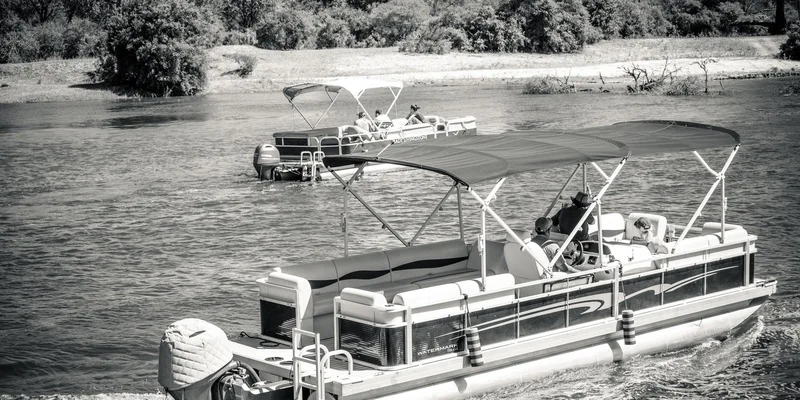
A pontoon boat is not complicated once the vocabulary is out of the way. It is a flat deck bolted to sealed metal tubes, with railings, furniture and an engine added on top. This guide explains what each part is, why owners keep talking about the third tube, and what the layout means for how the boat actually behaves.
This article contains affiliate links. If you buy through them, we may earn a commission at no extra cost to you. Learn more.
Quick Answer
What is a pontoon boat?
- A flat deck built on two or three sealed aluminum tubes, with railings and furniture on top instead of a molded cockpit.
- The tubes are called toons or logs, and a three tube boat is a tritoon.
- Buoyancy comes from the tubes, which is why pontoons are stable at rest and carry people well for their size.
- The tradeoff is ride quality in chop, which a tritoon improves considerably.
Bottom line: a pontoon trades the ride of a V hull for stability, deck space and easy boarding.
The Basic Anatomy
Strip away the furniture and a pontoon is three parts: the tubes that float it, a welded aluminum frame that spans them, and a deck laid over that frame. Everything a buyer looks at, the seating, the helm, the fence panels and the bimini, is fitted on top of that structure rather than being part of the hull itself.
That modularity is why pontoons are so easy to reconfigure. Furniture is bolted down and replaceable, fence panels come off, and layouts change from model to model without changing the boat underneath. It is also why a tired looking used pontoon with sound tubes can be worth rescuing.
Toons, Tubes and Logs
All three words mean the same thing: the sealed cylinders that provide buoyancy. They are usually aluminum, divided into internal chambers so damage to one section does not flood the whole tube, and they carry the entire weight of the boat. Their condition is the first thing to check on any used pontoon.
Two Tubes or Three: What a Tritoon Adds
A tritoon adds a third tube down the center line, which increases buoyancy, raises the horsepower the hull can carry and, with lifting strakes, lets the boat plane instead of pushing water. The result is a faster, drier and better handling boat, particularly in wind and boat wake.
The cost is weight, price and trailer size. A tritoon is heavier to tow and takes a wider trailer, and it is the reason so many pontoon buyers end up rechecking their tow vehicle. Our guide to real pontoon weights covers what that extra tube adds in practice.
Lifting Strakes and Performance Packages
Lifting strakes are fins welded along the tubes that push water down and lift the hull as speed increases. On a tritoon they turn a boat that plows into one that planes. Performance packages usually bundle strakes with thicker tube walls, under deck sheeting and sometimes a lifting fin at the back.
Whether you need one comes down to power and water. On a modestly powered family boat on a small lake, a performance package is money spent on capability you will not use. On a big lake with a large outboard, it is the difference between a comfortable boat and a wet one.
Pontoon Vocabulary Decoded
These are the terms that come up on every dealer lot and in every classified listing. Knowing them keeps you from nodding at a feature that does not matter for your water, or missing one that does.
| Term | What it means | Why it matters | When to care |
|---|---|---|---|
| Toon or log | The sealed flotation tube | Carries the whole boat | Always, especially used |
| Tritoon | Three tube configuration | Planes, handles chop, carries more power | Big water or watersports |
| Lifting strake | Fin welded along the tube | Creates lift at speed | Paired with real horsepower |
| Fence | The railing panels around the deck | Height affects wind and privacy | Windy lakes, small kids |
What Pontoons Are Genuinely Good At
Stability at rest is the headline. A flat deck on wide spaced tubes barely rocks when four people stand on one side, which makes swimming, fishing and eating aboard far more relaxed than on a comparable V hull. Boarding is level, gates are full width, and dogs and older passengers manage without help.
Capacity is the other one. For a given length, a pontoon seats more people more comfortably than any other family boat, because none of the deck is lost to hull shape. That is why they dominate lake rentals, family boating and anything involving a group rather than a crew.
Where Pontoons Fall Short
Rough water is the honest weakness. A two tube pontoon rides over chop rather than through it, so passengers get slap, spray and a tiring ride when the lake builds. Draft is shallow, which is good, but the flat deck catches wind and pontoons drift more than owners expect at anchor.
Anchoring is the other common complaint. The same wind that makes a pontoon pleasant to sit on also pushes it around, and a small anchor that would hold a runabout will drag. That is a solvable problem, and anchoring a pontoon properly covers the setup that actually holds.
What to Fit First on a New Pontoon
Most pontoons arrive short on the same handful of items: enough fenders for the rail, a boarding ladder that suits swimmers, a cover that fits the length and fence height, and shade if the bimini is small. Those four cover the majority of first season purchases.
Fenders are the one people skip and regret, because pontoon rails do not tolerate contact with a piling the way a fiberglass gunwale does. Rail mounted fenders hang from the fence rather than clipping over a gunwale, so the fitting matters as much as the size.

Frequently Asked Questions
What are the advantages of a pontoon boat? Stability at rest, a flat deck that seats more people than any comparable boat, level boarding through full width gates, and shallow draft. For groups, families and anyone who spends the day at anchor rather than at speed, those advantages are hard to beat.
What is the difference between a pontoon and a tritoon? Tube count. A pontoon rides on two tubes, a tritoon on three. The third tube adds buoyancy and, with lifting strakes, lets the boat plane, which means better handling, a drier ride and a higher horsepower rating.
Are pontoon boats safe in waves? They are stable but wet and uncomfortable in real chop, and a two tube boat is the worst of it. Tritoons handle it much better. Check conditions before heading out on open water and turn back earlier than you would in a V hull.
How long do pontoon tubes last? Sealed aluminum tubes last a long time when they are cleaned and not left submerged year round. The enemies are oxidation, mineral scale and impact damage, so tube condition on a used boat says more about how it was kept than the model year does.
Can pontoons be used in salt water? Yes, with the right preparation and a strict rinse routine, though salt is harder on aluminum and hardware than fresh water. Anything used in salt needs flushing, rinsing and closer attention to fittings, and boats that live in salt need bottom protection.
The Bottom Line
A pontoon is a flat deck on sealed tubes, and every strength and weakness follows from that: superb stability and space, a compromised ride in chop, and a third tube available to fix most of the second problem. If you are still comparing categories, our look at a deck boat against a pontoon puts the two side by side, and the accessories worth buying first covers what to fit once you own one.