Last updated: August 20, 2026
The battery aisle is where trolling motor buyers lose confidence. The motor was straightforward, thrust and shaft length and done. Then you get to the battery and everything is a group number, a chemistry, a cranking rating that has nothing to do with your motor, and a shelf full of boxes that all say marine on the label.
For a 12 volt trolling motor there are really only three decisions: deep cycle rather than starting, enough amp hours for the water you fish, and a case that physically fits the space and the box you already own. This guide takes them in that order and leaves the wiring questions where they belong.
This article contains affiliate links. If you buy through them, we may earn a commission at no extra cost to you. Learn more.
Quick Answer
What size 12V battery does a trolling motor need?
- Deep cycle, not a starting battery. Cranking amps tell you nothing useful here.
- Amp hours decide runtime, and Minn Kota advises at least a 110 amp hour deep cycle marine battery for best results.
- Group 24, 27 and 31 are the common cases; bigger group usually means more amp hours and more weight.
- Check the maximum amp draw your motor’s manufacturer publishes, then match capacity to how long you run it.
Bottom line: buy a deep cycle marine battery with the most amp hours that fits your space and your bow weight budget.
Deep Cycle, Not Starting
A starting battery delivers a large burst of current for a few seconds and hates being run down. A deep cycle battery is built to be discharged and recharged repeatedly, which is exactly what a trolling motor does all day. Using a starting battery for trolling duty shortens its life quickly and leaves you short of power sooner.
Dual purpose batteries sit in between and are a reasonable compromise on a small boat with one battery doing both jobs. If your trolling motor has its own battery, though, buy a true deep cycle. That is the single decision with the biggest effect on how long the battery lasts.
Ignore Cranking Amps on the Label
Cold cranking amps describe engine starting performance and say nothing about how long a battery will run a trolling motor. The number to find is the amp hour rating, usually written as Ah, and on some marine batteries a reserve minutes figure as well. If a listing hides the amp hour rating, treat that as a warning.
How Amp Hours Translate Into Time on the Water
Amp hours are a capacity measure. Divide the capacity by the current your motor is drawing and you get a rough runtime, which is why the manufacturer’s amp draw figure matters. Minn Kota publishes a maximum amp draw for each model in its support documentation and battery charts, and states plainly that this figure occurs only intermittently.
That last point saves a lot of confusion. Nobody runs a trolling motor at full throttle for hours, so real world runtime is longer than a worst case calculation suggests. Use the maximum draw as your pessimistic case and expect better if you spend most of the day at low and middle speeds.
Minn Kota’s Own Recommendation
Minn Kota states that its trolling motors will operate on any lead acid deep cycle marine 12 volt battery, and that for best results it recommends a deep cycle marine battery with at least a 110 amp hour rating. That is a useful floor to shop against, and it explains why so many anglers end up in group 27 or group 31 rather than group 24.
Group Sizes and What They Actually Mean
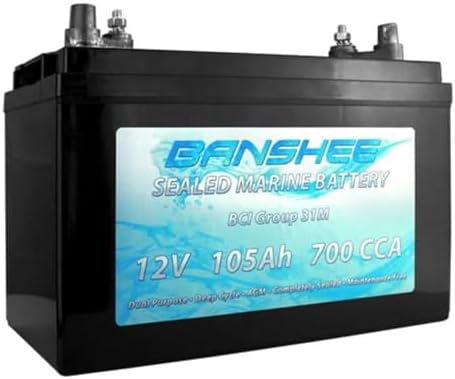
Group size describes the physical case dimensions and terminal layout, not the capacity. Group 24, 27 and 31 are the common marine sizes, in ascending order of footprint, and larger cases generally hold more amp hours and weigh more. Capacity still varies between brands within the same group.
Measure before you buy. The battery has to fit the compartment, the tray or box, and the hold down strap, and a group 31 that will not close in a group 27 box is a common and avoidable return. Our guide to battery boxes, trays and venting covers matching the box to the group.
| Group | Relative size | Typical fit | Watch for |
|---|---|---|---|
| Group 24 | Smallest of the three | Small jon boats, tight bow lockers | Lowest capacity, shortest days |
| Group 27 | Mid size | The common all round choice | Confirm the box and strap fit |
| Group 31 | Largest common marine case | Long days, higher thrust motors | Heaviest, and bow weight matters |
| Lithium | Varies by brand | Weight sensitive setups | Needs a compatible charger |
Chemistry: Flooded, AGM or Lithium
Flooded lead acid is the cheapest to buy, needs water checks and must stay upright and vented. AGM is sealed, spill resistant, handles vibration better and needs no watering, which is why it dominates the marine shelves. Lithium iron phosphate is far lighter and holds voltage under load, at a much higher purchase cost.
For a single 12 volt trolling motor battery, AGM is the default that suits most owners. Lithium makes the strongest case where bow weight matters or where you want a full day without the voltage sagging. Our comparison of lithium against lead acid goes through that tradeoff in detail.

Picking by Boat and Day Length
Small Boat, Short Sessions
A jon boat or small aluminum boat with a modest thrust motor and a few hours of fishing at a time is the one case where a group 24 makes sense, mostly because weight and space are tight. Accept that you are buying the shortest runtime of the three sizes.

Full Days and Higher Thrust
If you fish from dawn until the afternoon, or run a higher thrust 12 volt motor, group 31 is the practical answer. It carries the most capacity of the common marine cases, which is what buys you the back half of the day. The penalty is weight, and on a small boat that weight sits right at the bow.
What This Guide Does Not Cover
Circuit breakers, fuse sizing, cable gauge and any second battery joining an existing system are wiring decisions, and they are work for a marine technician or for the fitting instructions that came with your motor. This guide covers what to buy, not how to wire it, and that line is worth respecting on a boat.
The same applies to charging setups that live aboard. Picking the charger is a buying decision and we cover it in the onboard charger guide, but mounting and connecting one to a bank is not a job to improvise from a web page.
Frequently Asked Questions
How many amp hours do I need for a 12V trolling motor? More is better, and Minn Kota recommends at least a 110 amp hour deep cycle marine battery for best results with its motors. Beyond that floor, choose based on how long you fish and what physically fits your battery compartment and hold down.
Can I use a car battery for a trolling motor? You can make it run, but a car battery is built for starting bursts rather than repeated deep discharge, so it will fail early and leave you short on the water. Buy a deep cycle marine battery instead.
Will a bigger battery make my trolling motor more powerful? No. Capacity affects how long the motor runs, not how much thrust it makes. Thrust is set by the motor and the voltage of the system, which is why the step up in power is going to 24 volts rather than to a larger 12 volt battery.
Is AGM worth the extra over flooded? For most boat owners, yes. AGM is sealed and spill resistant, tolerates vibration and needs no water checks, all of which matter in a bouncing boat. Flooded batteries still work well if you can keep them upright, vented and topped up.
How long will a 12V trolling motor battery last? Runtime depends on capacity and how hard you run the motor, and service life depends mostly on how deeply you discharge it and how promptly you recharge. Our runtime guide walks through both.
The Bottom Line
Buy a true deep cycle marine battery, use the manufacturer’s published amp draw and Minn Kota’s 110 amp hour floor to set your capacity target, and confirm the group size fits the box and strap you already have. From here, the deep cycle chemistry guide covers AGM against flooded and gel in more depth, and the main trolling motor battery guide lines up the setups side by side.