Last updated: August 20, 2026
Getting the boat home is rarely the hard part. Getting it into the exact spot beside the garage, past the fence post, without a dozen forward and reverse corrections in a truck you can barely see out of, is what turns a ten minute job into half an hour of frustration. A trailer dolly exists for that last fifty feet, where the tow vehicle is the wrong tool.
This guide covers what a boat trailer dolly can and cannot move, how capacity and coupler fit decide which one works for your rig, and when the manual version is enough versus when a powered dolly earns its keep. It also covers the surface question, because a dolly that works beautifully on flat concrete can be useless on gravel.
This article contains affiliate links. If you buy through them, we may earn a commission at no extra cost to you. Learn more.
Quick Answer
What should you look for in a boat trailer dolly?
- Capacity first. Tow Tuff and similar makers publish a load capacity per model, and your loaded trailer has to sit under it.
- Coupler fit second. Dollies are built around a specific ball size, so a 2 inch coupler needs a dolly with a 2 inch ball.
- Wheels decide where it works. Flat-free tires and a large swivel caster handle rough concrete and packed gravel far better than small hard wheels.
- Manual dollies suit flat driveways and lighter rigs. Powered dollies are for slopes, heavier boats or anyone who cannot push a loaded trailer.
Bottom line: match the published capacity and the ball size, then pick wheels for the surface you actually park on.
What a Trailer Dolly Actually Does
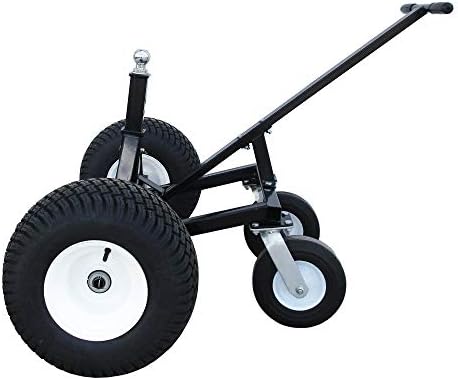
A trailer dolly is a wheeled handle that takes the place of the tow vehicle for short, slow moves. It clamps or latches onto the trailer coupler, lifts the tongue off the jack, and gives you a lever long enough to steer the front of the trailer by hand. The trailer’s own wheels still carry the boat.
That last point is what decides whether a dolly will work for you. The dolly only has to lift and steer the tongue weight and overcome rolling resistance. It is not carrying the boat, which is why a modest capacity rating can still move a surprisingly large trailer on a level surface.
Where It Beats the Truck
The real value is angle. A dolly turns the tongue far tighter than a hitched trailer will ever pivot, so you can jackknife a boat into a side yard or slot it alongside a house in one motion. It also lets one person park without a spotter, which is the reason most owners buy one.
Capacity and Tongue Weight
Two ratings matter and they are not the same. Load capacity is the total trailer weight the dolly is built to move, and tongue weight capacity is what it can lift at the coupler. Manufacturers publish both, and Tow Tuff lists a load capacity on each model in its dolly range so the comparison is straightforward.
Work from your loaded weight, not the bare trailer. A boat with a motor, full fuel, batteries, coolers and gear weighs considerably more than the hull figure, and the tongue carries a share of that. If your rig sits anywhere near a dolly’s published limit, move up a model rather than hoping.
Where to Find Your Numbers
The trailer’s own capacity plate or VIN sticker gives its rated figures, and the boat manufacturer publishes a dry weight. Neither is your real number on its own, but together they set the floor. A truck scale trip is the only way to know exactly, and it is worth doing once if you are close to a limit anywhere in the setup.
Wheels, Surfaces and Why Dollies Fail
Most disappointing dolly purchases come down to the surface rather than the dolly. Small, hard wheels roll well on smooth concrete and stall on gravel, grass, expansion joints and any slope worth mentioning. Larger flat-free tires with a proper tread pattern keep rolling where small casters dig in.
Flat-free construction matters for a second reason: a dolly lives in a corner of the garage for months at a time, and pneumatic tires go soft while they wait. Solid or foam-filled tires are ready when you are, which suits a tool used a handful of times a season.
Slope Is the Real Limit
Pushing a loaded trailer up even a gentle grade is much harder than the flat-ground rating suggests, and holding one back on the way down is harder still. If your driveway falls away toward the street, plan on a powered dolly or keep the tow vehicle involved. Chocks belong in your hand before the dolly comes off, every time.
Trailer Dollies by Situation
Level Driveway, Small to Mid Size Boat
For a jon boat, aluminum fishing boat or small bowrider on flat concrete, a manual dolly with flat-free tires and a swivel caster is usually all that is needed. Check that the ball on the dolly matches your coupler size and that the height adjusts to reach the coupler with the jack raised.
Heavier Rigs and Rougher Ground
Larger boats, tandem axle trailers and gravel or paver surfaces need a heavier frame, bigger wheels and a higher published capacity. The extra weight of the dolly itself is part of the deal, so consider where it will live and whether you can lift it into place.
Sloped Drives or Limited Strength
A powered dolly does the pushing for you, which changes the calculation entirely for anyone with a grade, a long move, or a back that objects to the manual version. Battery powered models are rated by capacity like manual ones, and the same coupler fit rules apply.

Moving a Small Boat Without the Trailer
Launching wheels are a different tool for a related problem: a set of wheels that bolt or clamp to the transom of a jon boat or small aluminum boat so it can be rolled down a bank without a trailer at all. Useful on shallow launches and rough shorelines, and no help whatsoever with a trailer.

Dolly Types Compared
| Type | Power | Best surface | Main limitation |
|---|---|---|---|
| Manual dolly | You | Flat concrete or asphalt | Slopes and heavy rigs get hard fast |
| Heavy duty manual | You | Concrete, pavers, packed gravel | Heavy to carry and store |
| Powered dolly | Battery drive | Most surfaces including mild grades | Needs charging and more storage room |
| Launching wheels | You | Beach, bank, shallow ramp | Only moves the boat, not the trailer |
Using a Dolly Without Denting Anything
The routine is simple and worth doing the same way every time. Chock the trailer wheels before you unhitch, latch the dolly onto the coupler and pin it, raise the trailer jack fully clear, then remove the chocks only when you are ready to move and have a hand on the dolly handle.
Move slowly and steer from the handle rather than shoving the frame. Keep the swivel caster free to rotate, watch the stern swing when you pivot the tongue, and set the chocks again before you unlatch. A boat that starts rolling in a driveway is not something you stop by hand.
Two Habits That Prevent Damage
Fit the coupler lock or pin so the dolly cannot pop off mid-move, and keep the tongue low enough that the trailer stays stable rather than tippy. Owners who skip both eventually discover how quickly a tongue drops when a latch lets go, usually onto a foot or a garage door track.
Common Mistakes When Buying a Trailer Dolly
The most common error is buying on price and getting small hard wheels that will not cross the joint between the driveway and the apron. The second is ignoring ball size, which leaves a dolly that cannot latch onto the coupler at all.
Underestimating loaded weight is the third, and it is the one that produces the strongest opinions in owner reviews. A dolly that struggles is not a defective dolly, it is a dolly bought for the dry hull weight instead of the boat as it actually sits with fuel, batteries and gear aboard.
Frequently Asked Questions
Will a trailer dolly move my boat on gravel? Only with large flat-free tires and a rated capacity above your loaded weight, and even then it takes real effort. Packed gravel is manageable, loose gravel is not. On loose surfaces a powered dolly is the realistic option.
What capacity trailer dolly do I need? Enough to cover your trailer plus the boat, motor, fuel, batteries and gear. Manufacturers such as Tow Tuff publish a load capacity per model, so compare that figure against your loaded weight rather than the hull’s dry weight.
Does the dolly ball have to match my coupler size? Yes, exactly as it does on the tow vehicle. A coupler latches onto its own ball diameter and nothing else, so check the dolly’s ball size before ordering.
Can I use a trailer dolly on a slope? Manual dollies are difficult on anything more than a very slight grade, and dangerous on a real one because a loaded trailer that starts moving cannot be stopped by hand. Use chocks, and use a powered dolly if the grade is part of your regular routine.
Is a trailer dolly better than a jack with a wheel? They solve different problems. A jack wheel lets you nudge a tongue a short distance, while a dolly gives real leverage and steering for parking a boat properly. Many owners keep both.
Do I still need wheel chocks if I have a dolly? Absolutely. The chocks hold the trailer while you attach and detach the dolly, which are the two moments the trailer is least controlled.
The Bottom Line
A boat trailer dolly is a narrow tool that solves one problem extremely well: parking a trailer by hand in a space the tow vehicle cannot manage. Buy on published capacity and coupler fit, choose wheels for the surface you actually have, and step up to a powered model the moment a slope enters the picture. For the smaller nudge-it-into-place job our trailer jack wheel guide covers the cheaper option, and our wheel chock guide covers what should already be in your hand.