Last updated: August 20, 2026
An anchor light is one of those items nobody thinks about until the sun drops faster than expected and you are still sitting in a cove with a boat full of people. Then it becomes the difference between being visible to the bass boat running back to the ramp and being a dark shape in his path.
The hardware itself is simple: an all round white light, mounted where nothing blocks it, showing in every direction. Where owners get stuck is the height question, the pole versus permanent question, and whether the light they already have counts. This guide covers all three, and points you at the right source for the rules themselves.
This article contains affiliate links. If you buy through them, we may earn a commission at no extra cost to you. Learn more.
Quick Answer
What anchor light does a boat need?
- An all round white light, unobstructed through a full circle, mounted where it can best be seen.
- Height matters because people, biminis and canvas block a light mounted too low.
- The Navigation Rules set out when an anchored vessel must show one; the USCG publishes them at uscgboating.org.
- Pole lights with a removable base suit most trailer boats, permanent masts suit boats that anchor out often.
Bottom line: buy an all round white light tall enough to clear your canvas and passengers, and check the rules at the source.
What an Anchor Light Is Supposed to Do
Its job is to tell another boat that you are there and not moving. That is why it is a single white light showing through a full circle rather than the red and green sidelights used underway. Someone approaching from any direction should see one steady white light and read it correctly.
Everything about the product follows from that. It has to be white, it has to be all round, and it has to be positioned where nothing obstructs it. A light that a bimini or a raised T top blocks from one side is not doing the job it was bought for.
The Rules, and Where to Read Them
The Navigation Rules cover when an anchored vessel must exhibit an anchor light, and they include exemptions tied to vessel length and to anchoring inside designated anchorages. The United States Coast Guard publishes those rules and boating requirement summaries at uscgboating.org, and that is where the thresholds should be read rather than in a product listing.
Do not take a number from a forum post or a marketing page. Read it from the source, then apply it to your boat and where you actually anchor. If you are unsure whether a particular spot counts as a designated anchorage, treat that as a reason to show the light rather than a reason not to.
State and Local Rules Vary
Registration, equipment carriage and local operating rules differ by state, and some waters add their own requirements on top of the federal ones. Check your state’s boating agency for anything specific to your lake or waterway rather than assuming the federal summary is the whole picture.
Height and Placement: The Part That Actually Fails
The rules describe a light shown where it can best be seen, and on a small boat that phrase does a lot of work. A short light mounted at the transom sits below head height, which means passengers, a raised bimini, a cooler stack or a T top can block it from one or more directions.
Taller is generally better for visibility, and the practical limit is what you can live with. A tall pole light is awkward to walk around on a small deck and catches wind. Most owners land on the shortest pole that still clears their canvas and their passengers when seated.
Check It From the Water
The easiest test is to have someone walk the dock or take the dinghy out at dusk and confirm the light shows from every angle around the boat. It takes five minutes and finds the blind spot that a catalog photo never will.
Anchor Light Styles Compared
There are four common approaches, and the right one depends mostly on whether your boat has an existing socket and how often you are out after dark. Attwood, Seachoice and Perko cover most of this market on the shelf.
| Style | How it mounts | Best for | Watch for |
|---|---|---|---|
| Removable pole | Plugs into an existing deck socket | Trailer boats, occasional use | Socket corrosion, storing the pole |
| Folding pole | Fixed base, folds down flat | Boats used after dark often | Hinge wear and water ingress |
| Fixed mast | Permanent mount, wired in | Larger boats anchoring out | Installation is technician work |
| Portable battery | Clamp, magnet or suction base | Small boats and backups | Battery life, secure mounting |
Pole Lights With an Existing Socket
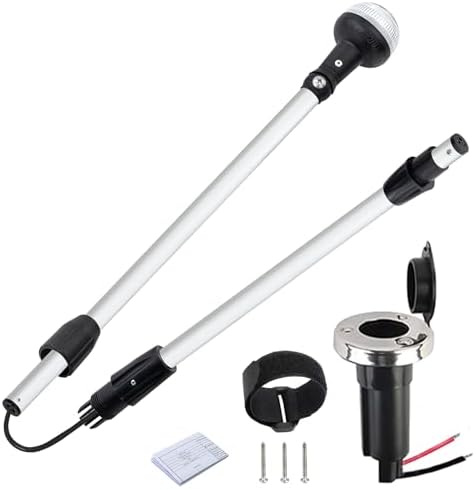
If your boat already has a deck socket at the stern, a plug in pole light is the simplest replacement there is. LED versions draw far less current than the old incandescent bulbs, which matters when the light burns for hours while the engine is off and only the battery is feeding it.
Check the base style before ordering, since sockets are not universal across brands. Clean the socket contacts while you are there, because corrosion in a stern socket is the most common reason a working light does not light.

Folding and Permanent Mounts
A folding pole light gives you a taller light without a pole to store, which suits boats that anchor out regularly or fish into the evening. It stays with the boat, folds down for trailering and goes up in seconds.
Permanently mounted lights and masts are a better answer on larger boats, but fitting one means running cable and adding it to a switch panel. That is wiring work for a marine technician, and this guide covers what to buy rather than how to wire it.
Battery Powered Options and Backups
Self contained LED anchor lights with their own batteries and a clamp, magnet or suction base solve two problems: small boats with no socket, and having a backup aboard when the fitted light fails at the worst moment. They are also useful on a kayak sized craft or a dinghy.
The tradeoffs are battery life and how securely the base holds. Check that the mount survives wind and wake without moving, and carry spare batteries. A backup light that has been in a locker since last season with dead cells is not a backup.

Power Draw and Your Battery
An anchor light left on overnight is a real load on a small battery, which is why LED is the sensible choice for anything you leave burning. It also explains why owners who anchor out find themselves thinking about battery capacity and a maintainer, not just the light itself.
If the boat sits without shore power between trips, our guide to battery boxes and secure mounting covers keeping that battery safe and accessible, and a solar maintainer covers the slow drain while you are away.
Frequently Asked Questions
Do I need an anchor light on a small boat? That depends on your vessel length and where you anchor, because the Navigation Rules include exemptions tied to both. Read the requirement at uscgboating.org and check your state’s boating agency, and when in doubt show the light.
How high should an anchor light be? High enough to be seen from every direction, which in practice means clearing your bimini, T top and seated passengers. The rules describe a light shown where it can best be seen rather than giving a height for small recreational boats, so test it visually from the water.
Can I use a regular white light as an anchor light? It needs to be an all round white light showing through a full circle, not a stern light or a work light. Look for a fixture stating that it meets the applicable USCG requirements for the type, and mount it unobstructed.
Is an LED anchor light better than incandescent? For anything left burning while the engine is off, yes. LED draws far less current, which preserves the battery you will need to start the engine, and the fixtures generally handle vibration better than a filament bulb.
Do I need a light if I am anchored in a marked anchorage? The rules include exemptions for vessels anchored in designated anchorage areas, with conditions. Check the current wording at uscgboating.org rather than relying on what someone told you at the ramp, since the exemptions are narrower than most boaters assume.
The Bottom Line
Buy an all round white LED light on a mount that clears your canvas and passengers, check visibility from the water, and read the actual requirement at uscgboating.org plus your state’s boating agency. Next, our safety equipment checklist covers what else belongs aboard, and the anchor guide covers holding the boat where you meant to stop.